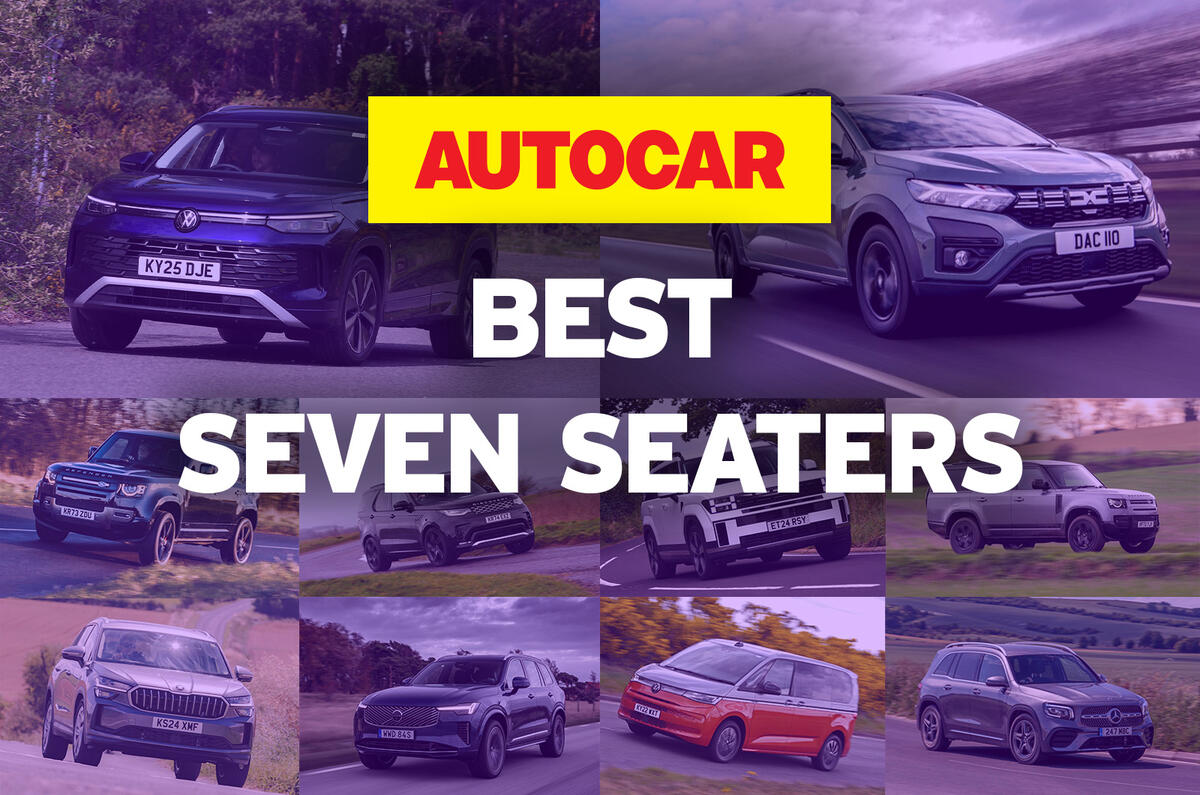
Currently reading: The best seven-seat cars: driven and ranked

Family haulers aren't restricted to MPVs any more. These are the 10 best seven-seaters you can buy today

Back to top

Not that long ago, seven-seat cars came in all shapes and sizes. Buyers could choose from estates, rugged off-roaders and even converted commercial vehicles – but the most popular way to transport seven was with an MPV.

Spacious and versatile, these 'multi-purpose vehicles' were perfect for growing families. Not only could they accommodate more people, they were packed with extra storage too and often boasted handy features such as sliding side doors. 

Yet tastes change and, with assistance of individuals such as Jeremy Clarkson lambasting MPVs for being 'uncool', seven-seaters have undergone a significant transformation.

Previously lauded and highly practical machines such as the Ford GalaxyVolkswagen Sharan and Renault Espace (the car that started it all) are largely gone and today's best seven-seaters are now predominantly fashionable SUVs.

Yet there are some outliers in this sea of rugged-looking pseudo 4x4s (although some do have some serious rough road talent), such as utlitarian vans with windows and a budget-friendly alternative that's more an enlarged estate than a crossover.

Either way, our top 10 list features also features cars with varying characteristics: some offer a third row best suited for occasional while others comfortably accommodate a group of adults and all their luggage.

While seven-seaters have become less common on the UK market, there’s still a solid list of options you can add to your shortlist. So read on as we dive into the top 10 best seven-seaters on sale today.


Advertisement

Read our review

Car review

MPV and SUV tropes fuse with a compact seven-seater of likeably humble aspect

Advertisement
https://images.cdn.autocar.co.uk/Dacia Jogger best 7-seat cars
  • Design8
  • Interior7
  • Performance7
  • Ride & Handling8
  • Costs10

Best for: Value

It's perhaps no surprise that the biggest breath of fresh air in the seven-seater market for a while has come from Dacia.

At just over 4.5m in length, the Jogger is a little shorter at the kerb than a typical C-segment MPV, but that doesn’t prevent it from offering usable passenger accommodation for up to seven.

The Dacia Jogger is a fully equipped people mover that will cost you less than the price of a mainstream supermini - making it the cheapest car on this list. 

Straddling the lines between estate, MPV and SUV, the Jogger contains enough space for seven adults, although the third row is best left to children on longer journeys.

With the rear seats lowered or removed completely, there's up to 2094 litres of carrying capacity available, plus several nearly packaged storage compartments tucked away around the cabin.

Another neat feature are the configurable longitudinal roof bars, sections of which can be turned through 90deg to create a roof rack.

Driving the Jogger is a mixed bag, but it's not bad. There's a supple, languid gait to its ride, while its turbocharged 1.0-litre petrol triple is a smooth and willing accomplice.

Light and accurate steering combines with a subtly raised seating position to make the Jogger easy to place on the road, and while it can roll like a drunk when cornering hard, the grip is strong and the handling always remains faithful.

It's far from a scalpel-sharp street fighter, but there's enough character in the way the Jogger goes about its business that it really should be considered if you're in the market for seven seats. 

https://images.cdn.autocar.co.uk/
  • Design8
  • Interior9
  • Performance9
  • Ride & Handling7
  • Costs9

Best for: Electric motoring

Electric cars are beginning to muscle in on the seven-seat act, and the Kia EV9 is one of the first of the bunch.

It may be all about style, impact and brand-building for its maker, but the EV9 should actually have a surprisingly rational grounding influence on the market for big electric cars.

You certainly won’t struggle to find it in a packed car park. It's roughly the same size as the Range Rover Sport and has a really bold design, so it possesses genuine presence. 

The sheer size of it and its clever packaging means it can offer six- and seven-seat cabin layouts. The former swaps the second row’s three-seat sliding bench for a pair of swivelling ‘captain’s chairs', a bit like you would find in the Mercedes-Benz V-Class luxury VIP shuttle.

Those third-row seats are big enough for small adults and kids with booster seats, which is useful as four of the five rear seats get Isofix points. Better still, the rearmost seats stow and deploy electrically meaning you won't break a sweat – or fingernails – when using them.

With all the seats up, the boot offers a family-hatchback-esque 333 litres of boot space, while five-seat mode makes it a very generous 828 litres.

The EV9 comes with a 99.8kWh battery. In the single-motor, rear-wheel-drive model, official range is 349 miles. Kia quotes efficiency of 3.0mpkWh and our testing achieved 2.8mpkW - good for a car with such a large, block-like frontal area but hardly outstanding. The official range of the dual-motor, four-wheel-drive model is 313 miles.

In cooler conditions, the top-of-the-line EV9 achieved 259 miles on our 70mph touring efficiency test and gave us reason to expect it would cover a little over 300 miles in exclusively urban and gentler out-of-town motoring.

https://images.cdn.autocar.co.uk/
  • Design9
  • Interior10
  • Performance6
  • Ride & Handling7
  • Costs7

Best for: Interior ambience

The Hyundai Santa Fe has always been one of our favourites in the seven-seat car market, and its 2024 renewal cemented its position as a go-to option. As practical as ever but now with genuinely eye-catching looks, the big Korean SUV will be a hit with growing families.

The interior is stylish, brilliantly practical and usable. Two small lapses, though: our test car's offside rear side window creaked in its seals and there’s nowhere to store the boot’s roller blind cover when using the third row of seats.

The Santa Fe comes with either a hybrid or plug-in hybrid powertrain, with maximum power standing at 249bhp. In PHEV guise, it offers up to 33 miles of electric-only range, which is slightly disappointing, but the rest of the package makes up for that. 

Boot size varies depending on specification and powertrain, but the seven-seat PHEV features 985 litres with its rearmost seats folded down (compared with 992 litres for the regular hybrid) or 621 litres with them in place, which is generous on all counts.

Partner its extensive practicality with its excellent material quality and lots useful tech and the Santa Fe justifies its high position in our top 10. 

Find Hyundai Santa Fe deals with Autocar

https://images.cdn.autocar.co.uk/VW Multivan best 7-seat cars
  • Design8
  • Interior8
  • Performance7
  • Ride & Handling8
  • Costs7

Best for: Versatility 

The Volkswagen Multivan is a traditional MPV: a thoroughly sensible and spacious box on wheels that offers unrivalled space and versatility. It may not be fashionable but, if what you want is space and stress-free way of transporting seven, it's hard to beat.

This is a relaxed, easygoing cruiser with a hugely spacious and practical interior. Only because of the architecture it uses, it has all of the capability to be equipped with the latest driver and safety assistance hardware and software.

A brilliantly rational form of family transport, it mixes one of the most flexible interiors in the business with grown-up driving dynamics and a dash of premium appeal.

Despite looking a lot like a van with windows, the Multivan actually sits on the MQB car platform, which underpins everything from the Volkswagen Golf to the Skoda Kodiaq. As a result, the slab-sided machine handles like a car, with surprising precision and brilliant ride refinement.

It also gets access to petrol, diesel and PHEV options. The latter uses a 1.4-litre petrol engine and an electric motor for 215bhp and a claimed 31 miles of electric-only running. That means there's pretty much a powerplant for every need, although the gutsy, refined and frugal 2.0 TDI diesel engine best suits the car.

The Multivan's trump card, though, is its modular interior, which can be organised just how you want it with more than enough space for seven passengers. Plus it has a sliding door on each side, which makes loading and unloading kids a doddle, especially in a tight parking spot.

Find Volkswagen Multivan deals with Autocar

https://images.cdn.autocar.co.uk/
  • Design8
  • Interior9
  • Performance8
  • Ride & Handling8
  • Costs7

Best for: Desirability

This desirable Land Rover Defender ought to have been a candidate for the top of this chart, because while it's expensive, its cleverly configurable interior presents the option of as many as eight seats.

I know it's big and tall and heavy, but it's such a good motorway car, with great visibility, big comfortable seats, a relaxed driving position and exceptional stability and isolation, even in bad conditions.

In long-wheelbase, five-door 110 form, there's a choice of five, six or seven seats (there's also an elongated 130 model that can seat eight in a 2-3-3 formation, but the extra seat isn't worth its car park space-busting size or ungainly rear overhang). 

No matter which option you go for, the 110 offers impressive versatility and packs an interior that effortless melds utlility and luxury. The 110 has third-row seats that are a little smaller than those of the closely related Land Rover Discovery's but still perfectly usable by children, teenagers and smaller adults.

However, this practicality doesn't come cheap, with even entry-level models starting from more than £60,000. But unlike the classic Defender, it drives nearly as well as almost any luxury SUV of its size and type, has a broad range of modern electrified powertrains and has off-road capability to spare.

There's even the option of the wild (and wildly expensive) Defender Octa, which combines the 626bhp twin-turbocharged 4.4-litre from the old BMW M5 and trick suspension to deliver a rough-and-tumble take on the idea of a driver's car.

Find Land Rover Defender 130 deals with Autocar

https://images.cdn.autocar.co.uk/
  • Design8
  • Interior8
  • Performance8
  • Ride & Handling8
  • Costs7

Best for: Third-row space

The third-generation Land Rover Discovery remains a fine full-sized seven-seat option, thanks to likeable charm and genuinely luxurious characteristics. 

The Discovery is a proper Land Rover: modernised, refined and as likeable as ever.

Launched in 2017 and updated in 2021, it comes with seven seats as standard. It's seriously spacious, with excellent head and leg room for all passengers, and vitally it tops the list for third-row space.

Boot space stands at a cavernous 1137 litres when you're using only five seats, but it drops down to 258 litres when using all seven.

Currently the Discovery is available only with a mild-hybrid diesel engine, offering 348bhp, a 0-62mph sprint of 5.9sec and decently frugality.

If there's a fly in the ointment, it's the lack of a plug-in hybrid option, which makes this a very expensive choice for company car drivers.

Apart from the Defender, then, the Discovery is probably your best bet on this list for performance and breadth of ability. Off road, there are few rivals that can touch its unstoppable brand of mountain goat agility.

It's pleasant inside too, with a lavish look and feel that's not far of a Range Rover for feel good vibes. There's also loads of standard kit (although the powered folding rear seats are an option on some models) plus JLR's latest Pivi Pro infotainment.

Find Land Rover Discovery deals with Autocar

https://images.cdn.autocar.co.uk/
  • Design7
  • Interior8
  • Performance8
  • Ride & Handling7
  • Costs8

Best for: Value hunters

Skoda branched out into the seven-seat SUV market in 2016, launching a car that split the difference between full-sized and mid-sized options quite cleverly.

Despite some evidence of cost-cutting and an interior that isn't quite the resounding success we thought it was, the Kodiaq strikes all the chords it needs to play. Even in base SE trim, it's equipped with everything it needs.

The Kodiaq, now in its second generation, has a big cabin and a generous boot for a car of its price and size, and all versions of it bar the base variant get seven seats as standard.

The one dimension in which the car is lacking a bit of space is cabin width. And because the middle second-row seat can't be slid into an offset position relative to both outer ones, it's tricky to get three child seats installed side by side (although only the outer two seats have Isofix points anyway).

The Kodiaq's engine range consists of a 1.5-litre turbocharged petrol with mild-hybrid assistance and a 2.0-litre diesel. There is a company car-friendly PHEV powertrain with an impressive 70-mile electric range, but it's available only with five seats. 

All Kodiaqs are pleasant and easy to drive, if a little bit firm-riding in some editions. That said, there are plenty of trim levels to choose from (as well the extensive engine line-up), which means there should be one to suit most tastes and budgets.

There's even a hot vRS flagship version, which combines four-wheel drive with a detuned 261bhp version of the Volkswagen Golf R's 2.0-litre petrol engine. It's not the last word in precision and poise, but it is a surprisingly rapid point-to-point machine.

https://images.cdn.autocar.co.uk/
  • Design8
  • Interior7
  • Performance7
  • Ride & Handling8
  • Costs7

Best for: Powertrain selection

The all-new Tayron SUV replaces the Tiguan Allspace as Volkswagen's seven-seat SUV. However, like its predessor, it's essentially a stretched version of the Tiguan.

It’s easily the best in its class to drive and particularly comfortable when fitted with the adaptive dampers, but it offers less space and creature comforts in the third row.

Like that smaller car, the Tayron is available with a huge range of powertrains, including petrol, diesel, mild hybrid and plug-in hybrid. 

It's a good all-around option with accessible driving dynamics, a pleasant interior and frugal powertrains, but that third row will be very tight for anybody beyond secondary school.

However, as with the closely related Skoda Kodiaq, the PHEV version (which has a 70-mile electric-only range) isn't available with seven seats. 

Find Volkswagen Tayron deals with Autocar

https://images.cdn.autocar.co.uk/
  • Design7
  • Interior8
  • Performance6
  • Ride & Handling7
  • Costs8

Best for: Daily driving

The fact that the Volvo XC90 has been on sale for almost 10 years is a testament to its compelling blend of space, practicality, comfort and class - and a 2025 facelift has kept things fresh.  

Volvo's passive suspension has worked wonders. There’s less pitter-patter at low speed on loose surfaces and in general it just feels like a large car, rather than an out-and-out 4x4, absorbing bumps and crests without too much float or wallow.

Some rivals are sharper to drive, but the XC90 offers a great balance of performance, efficiency and low running costs - especially in its plug-in hybrid form.

The XC90’s greatest strength is its roomy, well-equipped interior, which is of high quality and smartly finished. It has enough space for seven adults to travel in comfort, with the third-row seats serving up good head and leg room. 

The range opens with the B5 mild-hybrid petrol with 247bhp, which is just about muscular enough to cope with the XC90's mass but sounds strained when extended. Then there's the refined T8 plug-in hybrid, which offers a useful 443bhp punch. However, with just 44 miles of electric-only range it falls into the 9% benefit-in-kind tax bracket, which is higher than rivals that can go much farther on a charge.

Whichever powertrain you choose, this Volvo is composed and capable on the road. Its emphasis is on comfort and refinement, rather than an uplifting driving experience, but that's perfectly in keeping with its remit. It remains an oldie but a goodie.

https://images.cdn.autocar.co.uk/
  • Design8
  • Interior8
  • Performance6
  • Ride & Handling7
  • Costs8

Best for: Simplicity

Launched over 30 years ago, the original Citroën Berlingo was one of the pioneers of the 'van with windows' genre. Designed with the sort of Gallic rationality that underpinned automotive greats such as the 2CV, the boxy machine offered acres of space and bags of charm for a bargain price.

The flagship Max trim adds useful features such as opening tailgate glass (like on old BMW estates) and a rear-view camera, plus the option of the Modutop, which adds extra, aircraft-style overhead storage.

The latest Berlingo is more refined, more sophisticated and even more spacious, but it retains the charming simplicity of its predecessors. The standard car is a five-seater, while the seven-seater gets a longer body and an 'XL' badge. Its third-row seats offer decent space, even for adults, and can be folded flat to deliver a generous 1050 litres of luggage space. Lower the second and third rows and the carrying capacity jumps to a cavernous 3500 litres.

As you'd expect, there's plenty of space inside the Berlingo, plus loads of handy storage, including a double glovebox. Better still, the second row features three Isofix points, so you can fit a trio of child seats. And while the interior isn't in any way premium, its well laid out and packed with all the kit you will need.

You can have either an electric powertrain or a 1.5-litre diesel engine. The former features a 134bhp motor, but a 52kWh batttery and a claimed range of just 206 miles makes it a little limited. The latter is available with 99bhp and six-speed manual gearbox or 128bhp and an eight-speed automatic. Frugal, refined and with just enough mid-range grunt for most everyday situations, the punchier diesel is our pick.

Whichever version you choose, though, the Berlingo offers a typically French driving experience that prioritises a comfortable ride and ease-of-use over seat-of-the-pants thrills. Yet it still handles accurately and, despite lacking top-notch refinement, always leaves you feeling more relaxed at journey's end than you did at the start.

Find Citroen Berlingo deals with Autocar

James Disdale

James is a special correspondent for Autocar, which means he turns his hand to pretty much anything, including delivering first drive verdicts, gathering together group tests, formulating features and keeping Autocar.co.uk topped-up with the latest news and reviews. He also co-hosts the odd podcast and occasional video with Autocar’s esteemed Editor-at-large, Matt Prior.

For more than a decade and a half James has been writing about cars, in which time he has driven pretty much everything from humble hatchbacks to the highest of high performance machines. Having started his automotive career on, ahem, another weekly automotive magazine, he rose through the ranks and spent many years running that title’s road test desk. This was followed by a stint doing the same job for monthly title, evo, before starting a freelance career in 2019. The less said about his wilderness, post-university years selling mobile phones and insurance, the better.