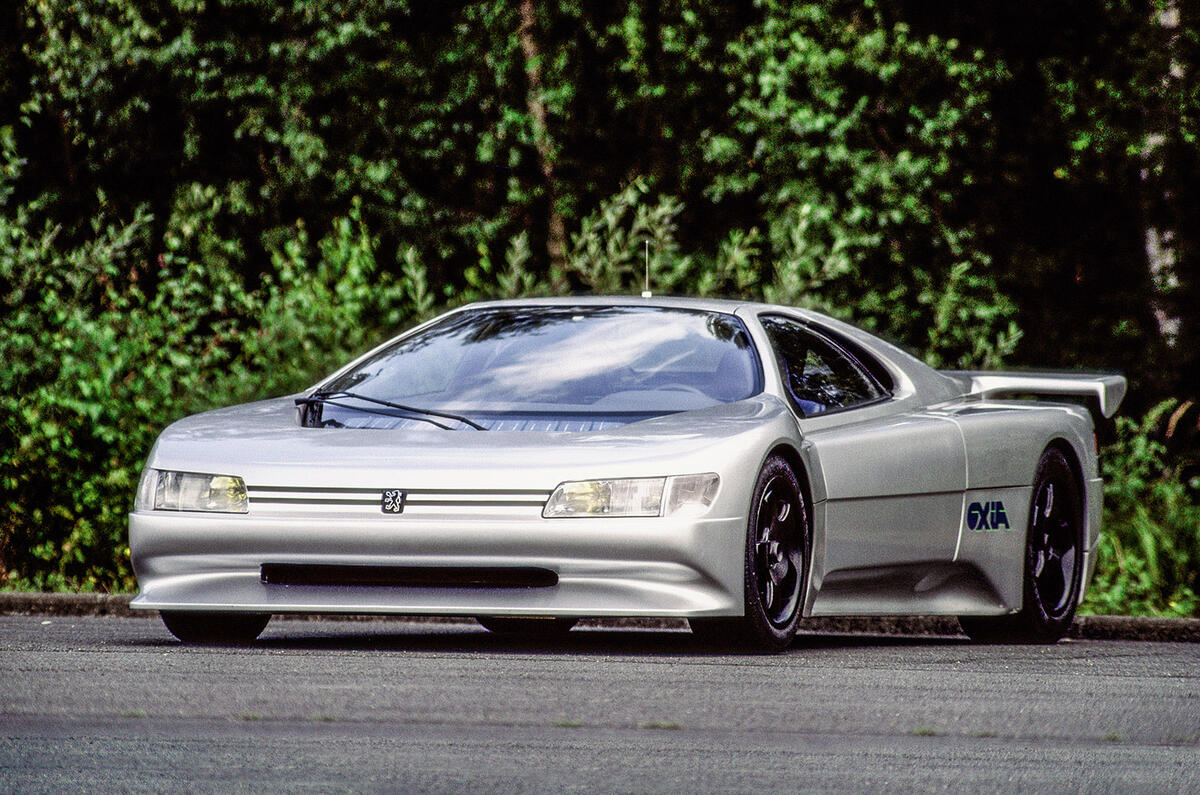

From some angles, it is possible to just glimpse elements of the road-going 405 Coupé in the Oxia, which was Peugeot’s star attraction at the 1988 Paris motor show.
Named after the part of Mars that lies at longitude and latitude zero, the Oxia was a fully engineered design study “that ought to give Ferrari and Porsche some food for thought”, according to John Simister, Autocar’s chief features writer at the time.
The Oxia was more than a static design study, though. All four wheels drove and steered, a twin-turbo V6 gave 680bhp and the body and chassis were crafted from carbonfibre and Kevlar.
The Oxia weighed 1377kg, with the complex transmission – featuring an epicyclic centre differential giving a torque split of 25% front, 75% rear and incorporating a Ferguson viscous coupling, plus electronically controlled limited-slip differentials front and rear – and steering accounting for a lot of that. Suspension was by double wishbones all round, with each of the gas-filled dampers surrounded by a pair of concentric coil springs.
Beneath its sleek skin, the Oxia was a fusion of Group B rally car and Group C sportscar racer. Its engine was a 2849cc V6 with two Garrett T3 turbochargers, derived from the WM-Peugeot Le Mans cars that were famed for hitting 250mph on the Mulsanne Straight, and the four-wheel drive system was a refined version of the Peugeot 205 T16’s. The car delivered its blistering 680bhp at 8200rpm and an equally impressive 535lb ft at 4500rpm.
“The two occupants sit well forward behind a steeply raked windscreen, the bottom edge of which, barely 2ft from the Oxia’s nose, incorporates two rows of photoelectric cells to power the air-con fan when the engine isn’t running,” said Simister. “It’s a logical solution: more sun means more power means a faster fan means more airflow. Very Group C, too, are the way the rear wheels sit so far back, and the plethora of scoops and louvres.”
Simister watched the car in action around the Belchamps test track. “At low revs it sounds a little like a Porsche 911 or maybe a 959,” he wrote. “First gear is long, as you would expect from a car which could well be capable of 200mph with the right gearing – Peugeot will say only that it can top 180mph – but the Oxia pulls away cleanly and disappears from view around the banking.
“When it reappears, the engine is grunting lustily, the giant stainless steel silencer curbing some volume but making little impression on the bass and treble.
“Oxia is chased by a 405 Mi-16 as it hoves back into view, so it can’t be going any faster than about 135mph. Its rear wing would still be flat, for it doesn’t reach its 3deg raised position until 155mph. Once raised, though, it stays there for a full minute after the Oxia’s speed falls below this point.”
Fast-changing parameters such as road speed, engine speed and boost pressure were monitored by conventional analogue gauges, with digital displays reserved for fuel level, engine temperatures and odometer.
A built-in personal computer, with a colour LCD screen, an alphanumeric keyboard and a floppy disc drive, controlled the air conditioning system. It also controlled navigation databases and route finders. A map then displayed the chosen route on the screen. Also included were a radio telephone and a Pioneer hi-fi system.