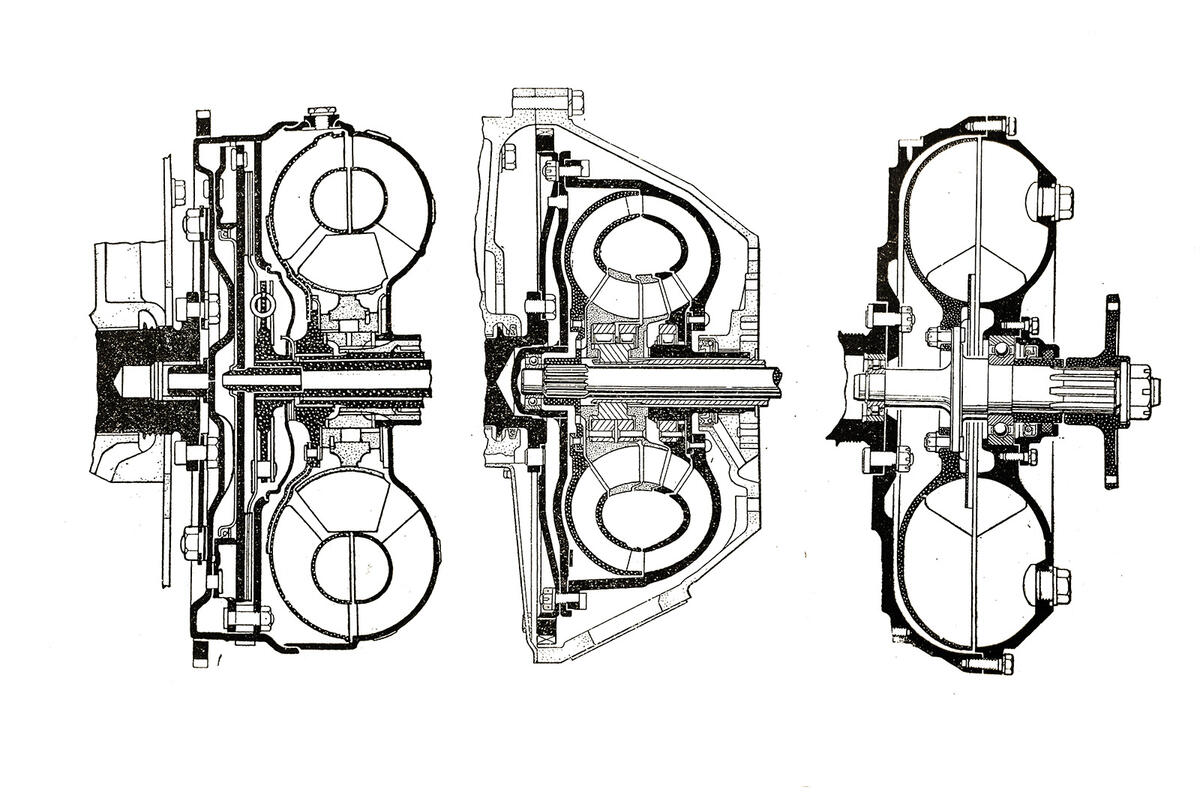

Following World War 2, automatic transmissions became commonplace on American cars, prompting Autocar to ponder how long it would be before similar systems were adopted by British car makers.
“Very shortly some decision will have to be made in order that British cars can continue to hold their own against American competition,” wrote technical expert MS Crosthwaite in the magazine, in August 1950.
“There is no doubt at all that car users who regard the automobile primarily as a means of transport will no longer continue to view the conventional clutch and synchromesh gearbox with favour. Elimination of the clutch pedal would appear to be an absolute necessity.”
Crosthwaite detailed three types of automatic transmission – the semi-automatic overdrive, a four-speed ‘planetary’ gearbox and a fully automatic torque converter – and assessed their suitability for the British market.
“Two factors are of vital importance when considering a transmission for British cars, namely, what may be considered ‘reasonable’ efficiency and whether fully automatic control is desirable,” he wrote.
“Behind any consideration of these arguments, however, lies the question of environment and its effect upon the type of vehicle most suitable.
“In many ways the narrow twisting roads of Great Britain, with their high traffic density, have no counterpart. Thus ease of gear changing is essential, although the actual percentage of the life of the car spent in intermediate gears may not be unduly high. Nevertheless, it will be enough to show up in terms of fuel consumption any relatively low transmission efficiency.”
At the same time, he identified two factors contributing towards the need for a reconsideration of gear ratios.
“These are the reduced drag of modern coachwork, resulting in the possibility of attaining higher road speeds with a given engine power, and the realization that in other countries, where high cruising speeds can be sustained for long distances, a higher top gear ratio is desirable in order to keep engine speeds reasonable.”
Ultimately, Crosthwaite felt that other technical elements of the car could play a more important role in improving fuel economy than transmission evolution.“No transmission is an end in itself. The ideal is to have so much surplus engine power that nothing is required beyond a device to provide a smooth start,” he wrote. “While this desirable state is approached by the large-capacity American car, it cannot be expected in other countries where fuel is expensive.
“The alternative is, however, open to all. It lies in more effort devoted to reducing weight and drag. No amount of transmission development can replace the need for these improvements.”
Previous Throwback Thursdays
4 March 1899 - Steam, electric or combustion engine?
26 June 1906 - The first French Grand Prix