










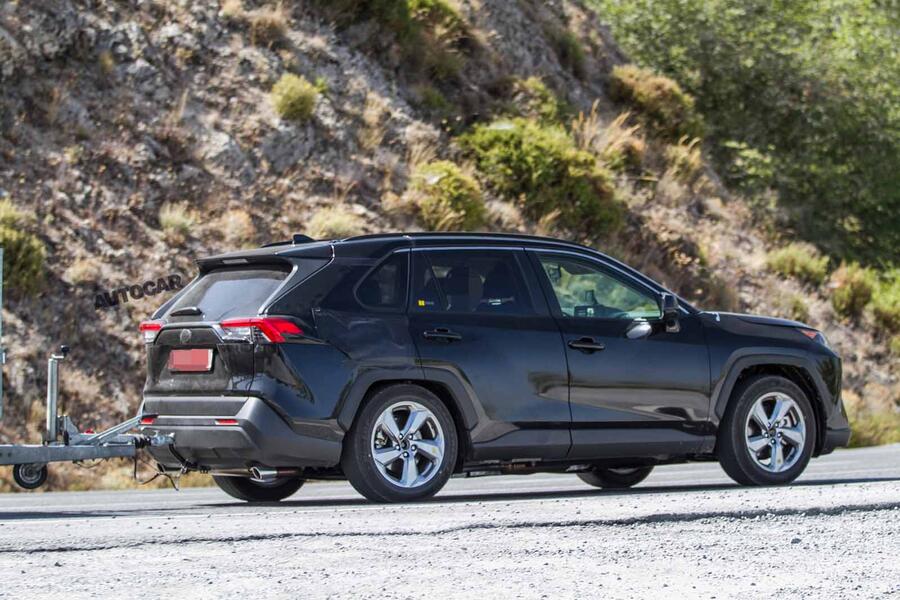
Toyota has been seen testing what appears to be a plug-in hybrid variant of the Toyota RAV4 SUV on European roads.
At first glance, the prototype doesn't seem any different from the standard Honda CR-V rival. However, closer inspection reveals a disguised opening on the right-hand side of the car – the opposite side of where the fuel filler cap resides – a classic tell that a charging port is lurking underneath.
The test hack is also towing what looks like dynamometer equipment, another traditional sign of a new powertrain under development.
While Toyota is unable to officially comment, it's most likely that a PHEV RAV4 would continue to use the 2.5-litre Atkinson cycle four-cylinder petrol engine mated to a larger electric motor and lithium ion battery pack.
While the Japanese maker already has a PHEV in its arsenal in the form of the Prius Plug-in, that 1.8-litre unit is unlikely to provide sufficient power and torque levels to account for the substantial weight increase usually seen with a plug-in hybrid - for reference, the straight hybrid model already weighs around 1750kg.
The TNGA platform underpinning the SUV has been designed to offer a mix of powertrains. Expect an all-electric range target of about 30 miles, allowing a quotable low-CO2 figure to satisfy business users.
Toyota has long been an advocate of its so-called 'self-charging' parallel hybrid system – used in the Prius for two decades – claiming it's more convenient than having to plug in. However, all car makers will be forced to drive down their fleet average CO2 rating rapidly or face heavy fines as new EU emission laws come into force in 2020/21.
Electrification with a meaningful all-electric range is the most effective way of doing so. As such, expect a plug-in hybrid RAV4 to arrive on the scene in the middle of 2020, rivalling models such as the Mitsubishi Outlander PHEV and Vauxhall Grandland X PHEV.
Read more
Toyota and Subaru to develop new electric platform and SUV
Toyota to ramp up EV plans with six global models
Toyota Prius Plug-in long-term test review