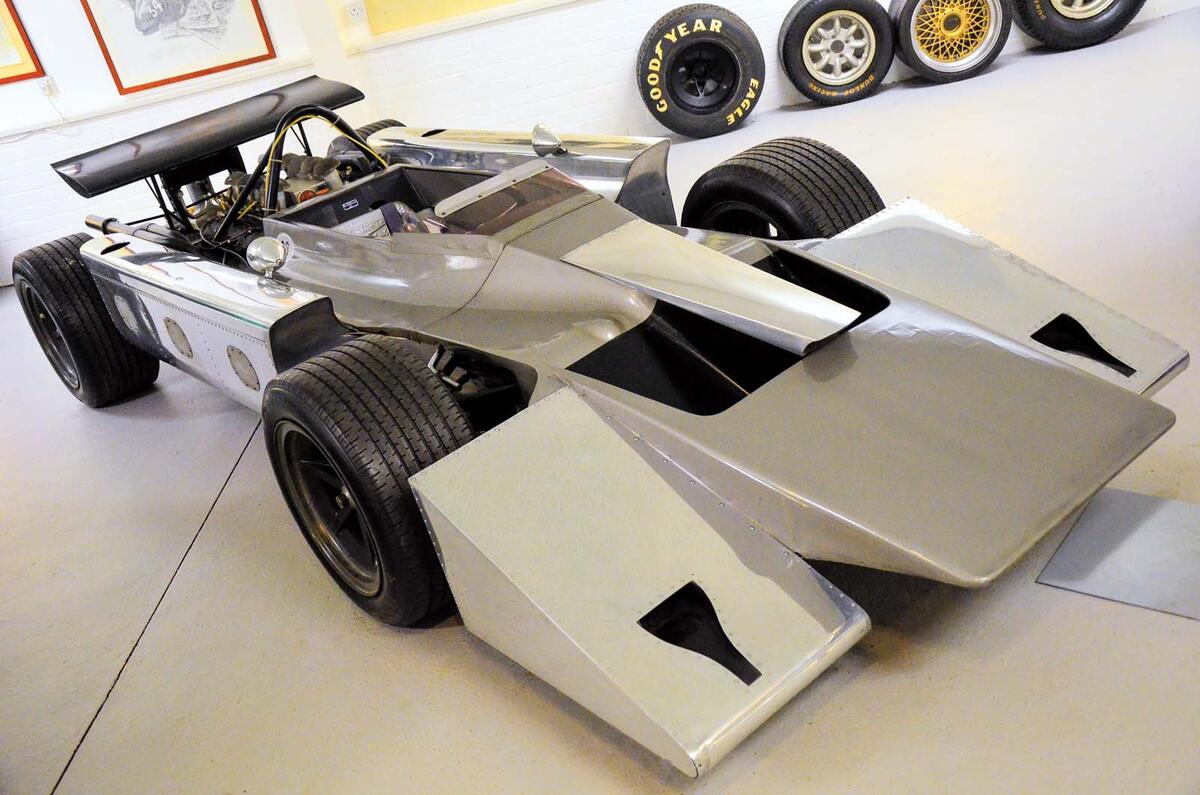

Cosworth became famous the world over in the late 1960s as its Ford-funded ‘DFV’ V8 engine totally dominated Formula 1 – something it would continue to do throughout the 1970s.
In fact, its final grand prix win didn’t come until 1983. It’s one of the most admirable of the many ‘blokes in a shed beat all the car industry giants’ stories Britain produced in the last century. It’s not well known, though, that Cosworth at this time created not only its own F1 engine but its own F1 car – and a highly unconventional one at that.
This unnamed racer was dreamed up by Cosworth co-founders Mike Costin and Keith Duckworth, both former Lotus engineers, and Robin Herd, who started his career as a design engineer on Concorde, and then designed McLaren’s first-ever grand prix winner.
“It is something entirely new in single-seater aerodynamics, structure and the detail arrangement of the transmission,” we reported on its July 1969 unveiling.
The Cosworth was far from alone in using four-wheel drive. The potential of a 4WD system had been shown as long ago as 1961, when Stirling Moss had won a non-championship race in an F1 car created by British tractor company Ferguson (which had then in 1966 contributed the first 4WD system for a road car, the Jensen FF), and it was an obvious solution when F1 engines became so powerful (with more than 400bhp) that cars started to struggle to put it all down.
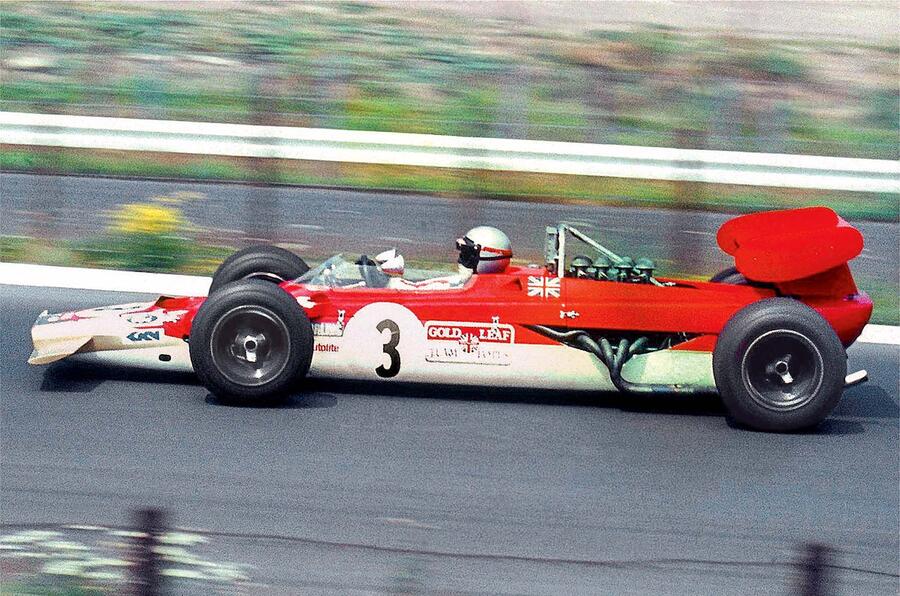
Lotus had seemed to prove the theory by almost winning the 1969 Indianapolis 500 with a gas-turbine 4WD car, and Matra’s Jackie Stewart told us: “There isn’t a tail slide and there isn’t a lot of understeer; you can balance the car much better and therefore you can get out of corners quicker, and if you do that, you get down the straights quicker.”
Enjoy full access to the complete Autocar archive at the magazineshop.com
Working on 4WD were Cosworth, BRM, Lotus, Matra, McLaren and Ferrari. Most integrated Ferguson’s proven system into existing chassis, but Northampton went its own way.
We reported: “Drive is taken from the engine, which is installed with the flywheel end forward, to a two-shaft gearbox with Hewland gears to give a wide choice of ratios.
An extra gear, mounted on the end of the second motion shaft, takes the drive sideways to an angled bevel differential from which it is taken to the front and rear final drives. The torque-split ratio is likely to be about 40:60 front to rear, with further adjustment possible by altering front and rear wheel diameters.