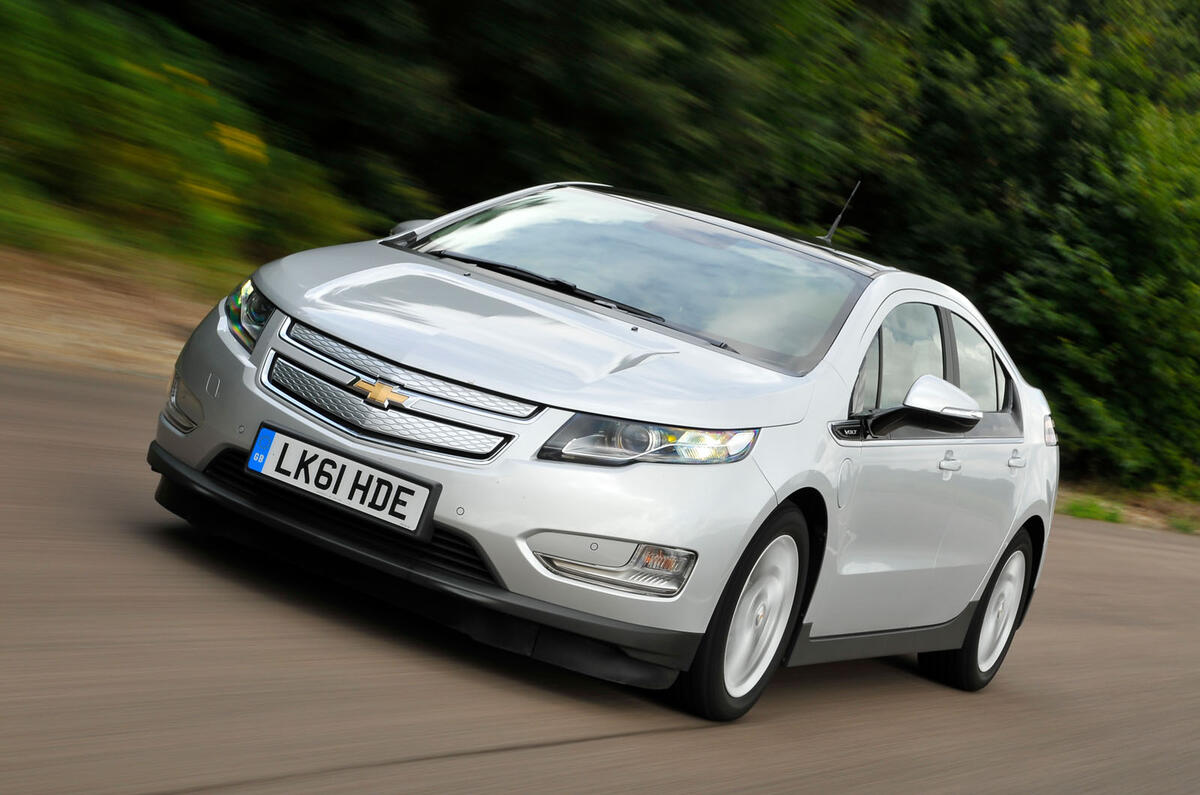
It’s not often that one can feel a little sympathy for an industrial giant like General Motors.
But you might feel a shred or two when you consider the pioneering effort, and hard cash, that was sunk into the unsuccessful Chevrolet Volt project. This was a car that was intended to take on the mighty Toyota Prius, not by merely matching that car’s technical and ecological ambitions, but travelling well beyond them.
Essentially it was a plug-in hybrid, a common enough machine today but back in 2011 this was technical adventurism.
Indeed, when the project to build the car was well under way, there were elements of it that had yet to become technically feasible for mass production, not the least of them its lithium-ion battery pack. These were among the many obstacles facing the Volt’s development, some predictable, like the need for lithium-ion technology, others entirely unforecast, such as General Motors’ post-2008 bankruptcy.
The inspiration for the Volt was in large part the Toyota Prius, a hybrid that has enjoyed success well beyond its maker’s dreams and a car whose popularity increasingly irked high-ups at General Motors and one Bob Lutz in particular. Lutz was then one of the US car industry’s most famous “car guys” and, having been persuaded to join GM as number two at the age of 66, nursed the idea of leapfrogging Toyota with an all-electric car.
This despite the wave of adverse (and largely unfair) criticism GM had earned when it terminated the semi-experimental, two-seat EV1 project (picured below). Lutz would soon be persuaded by colleague Jon Lauckner, who was in charge of all GM’s vehicle lines, that the energy density of batteries was insufficient for a realistic range, and that a plug-in hybrid was needed.

Lauckner sketched the electro-mechanical architecture of this vehicle on a notepad, Lutz recalls, using a gold-nibbed fountain pen. “Pushing that abused pen against the rake of the nib when necessary (resulting in a spray of ink droplets) Jon sketched the chassis,” writes Lutz in his highly entertaining book “Car Guys vs Bean Counters”.
“The sixteen kilowatt battery goes down the middle and out like a T under the back seat,” explained Lauckner. That’s nominally good for 80 miles, but we’ll only use eight kilowatts; that’ll make the battery last forever. This way, it’s good for 40 miles, and then we’ll cut in this little 1.4 litre engine, which will drive a generator to keep the battery supplied with juice for another, say 300 miles.”


Add your comment