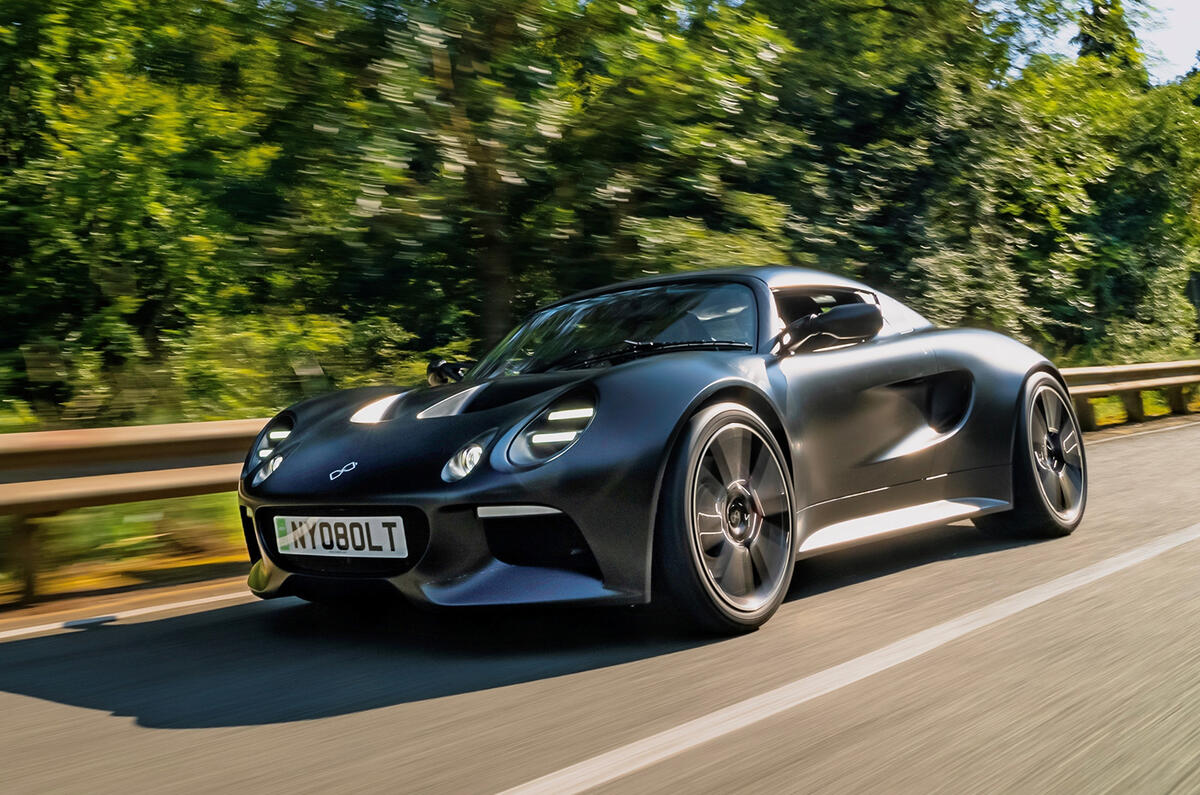
It's a feeling akin to jet lag – that unmistakable sensation of time shifting in a way that your brain can't immediately comprehend.
Three minutes ago, I plugged this Nyobolt EV into an electric charger with its battery displaying 30%. It's now breached 80% and its rapid, 300kW charge speed has begun to tail off.
I have never actually timed myself filling a car with petrol, but it can't be significantly quicker than this.
There are numerous barriers to the mass adoption of EVs, several of which this Lotus Elise-esque roadster can't hope to fix. Nyobolt might not make any examples beyond this tech demonstrator. If it does, the resulting car is never going to be cheap enough for government grants, nor flexible enough for family life.

But what it can do is charge at a speed that might flip many sceptics' thinking on its head. The Cambridge company has proven its technology via a 10-80% charge in 4min 37sec and my own experience today has given welcome legitimacy to its claims.
At its prototype's heart is a modest-sounding 35kWh battery that can charge at 350kW, giving it '10C' capability.
A battery's C-rating denotes how quickly it can fully charge or discharge relative to its total capacity, a 1C rating equating to one hour and 10C equalling 10 minutes. The rating varies throughout a battery's state of charge, naturally peaking between 10% and 80%. It's not yet common parlance when comparing EVs, nor typically quoted by car makers, but a similarly 350kW-capable Hyundai Ioniq 5 is likely to sit around the 3C marker in real-world use.
So while the Nyobolt's dramatic, Callum-designed styling surely has you clamouring for power outputs and 0-62mph times – 470bhp and sub-4.0sec, FYI – it's the charging innovation beneath that's really worth interrogating.
The tech that enables such quick top-ups – therefore allowing a downsized battery to better play into a two-seat sports car's need for agility – "is all based around the cell level", according to Shane Davies, director of vehicle battery systems at Nyobolt.
"What's so different is our anode material within the cell composition, then the system design of the cell itself. It results in very, very low impedance at the cell level, which in turn results in low heat generation. We don't need to work on any trick cooling solutions."


Join the debate
Add your comment
Charging a typical 85kWh EV battery at a peak rate of 10C will require a charger capable of 850kW. Do such things exist?
Yes BYD has 1MW (1 Mega watt /1000 KW) chargers in China to fuel their Han L and Tang L saloon/SUV cars.
They are supposedly bringing both the cars and the chargers to Europe in 2026.
Charging a typical 85kWh EV battery at a peak rate of 10C will require a charger capable of 850kW. Do such things exist?
Thank you for correcting the C question. I thought it looked wrong. It does seem a strange way of describing it. Why not just say 10min, 20min,30min - that being the information people want to know. Possibly it is to do with linearity when comparing e.g . 2C is obviosuly twice as fast as 1C?