Currently reading: Quicker than petrol? This 'Elise EV' changes the charging game

Nyobolt's battery design generates less heat so can charge and discharge quickly, key for electric sports cars

It's a feeling akin to jet lag – that unmistakable sensation of time shifting in a way that your brain can't immediately comprehend.

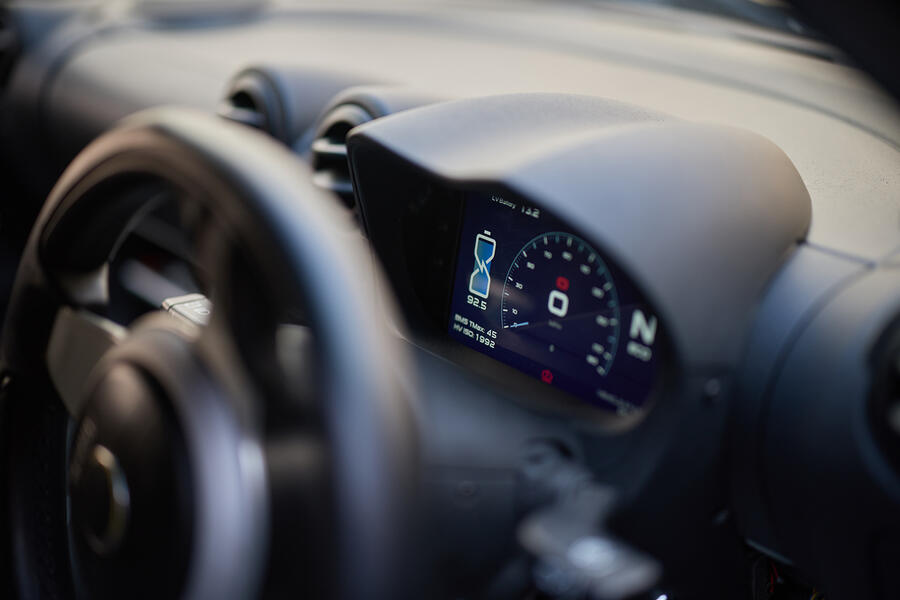
Three minutes ago, I plugged this Nyobolt EV into an electric charger with its battery displaying 30%. It's now breached 80% and its rapid, 300kW charge speed has begun to tail off.

I have never actually timed myself filling a car with petrol, but it can't be significantly quicker than this.

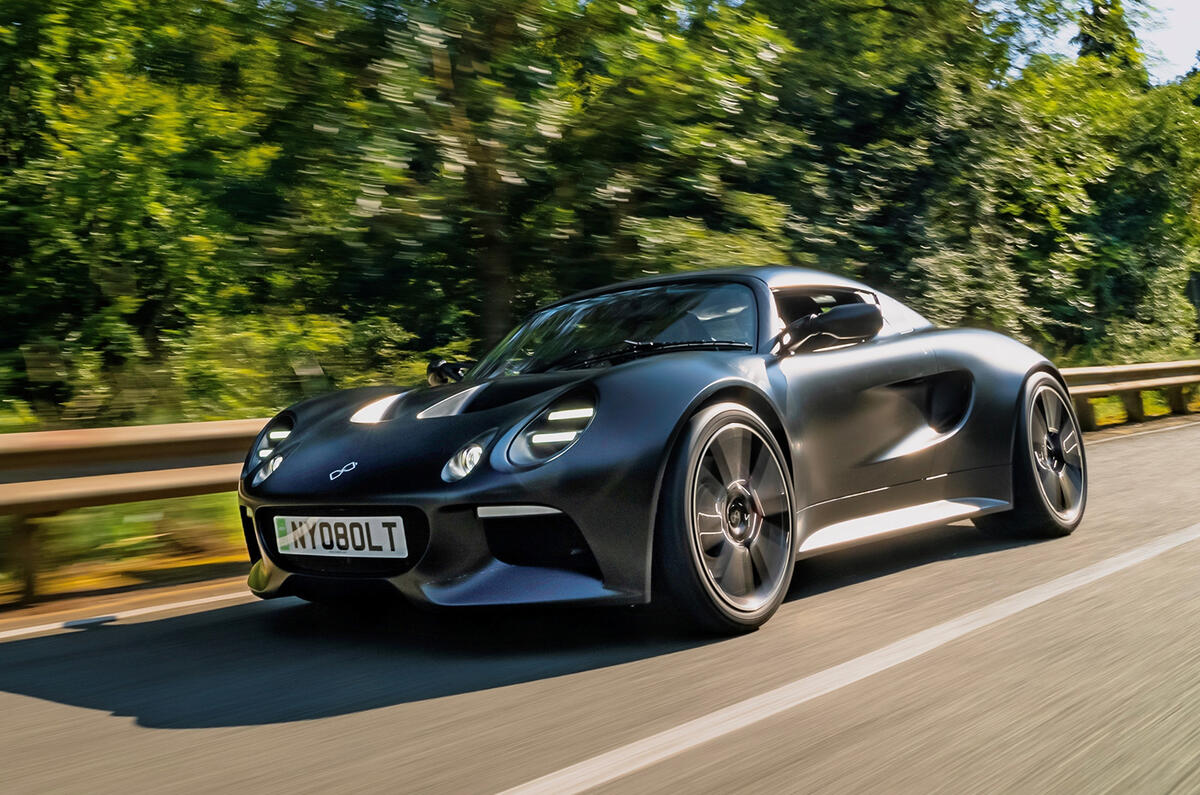
There are numerous barriers to the mass adoption of EVs, several of which this Lotus Elise-esque roadster can't hope to fix. Nyobolt might not make any examples beyond this tech demonstrator. If it does, the resulting car is never going to be cheap enough for government grants, nor flexible enough for family life.
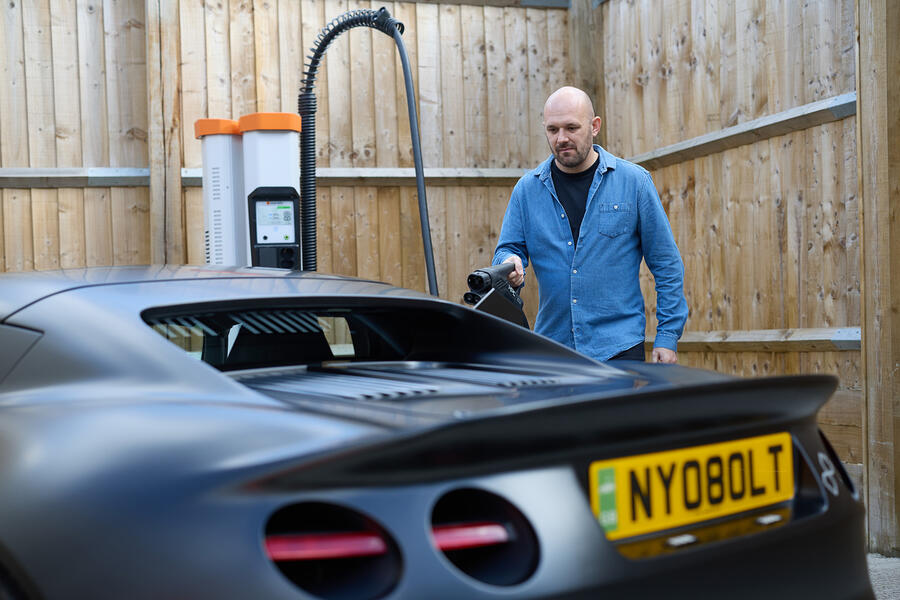
But what it can do is charge at a speed that might flip many sceptics' thinking on its head. The Cambridge company has proven its technology via a 10-80% charge in 4min 37sec and my own experience today has given welcome legitimacy to its claims.

At its prototype's heart is a modest-sounding 35kWh battery that can charge at 350kW, giving it '10C' capability.

A battery's C-rating denotes how quickly it can fully charge or discharge relative to its total capacity, a 1C rating equating to one hour and 10C equalling 10 minutes. The rating varies throughout a battery's state of charge, naturally peaking between 10% and 80%. It's not yet common parlance when comparing EVs, nor typically quoted by car makers, but a similarly 350kW-capable Hyundai Ioniq 5 is likely to sit around the 3C marker in real-world use.

So while the Nyobolt's dramatic, Callum-designed styling surely has you clamouring for power outputs and 0-62mph times – 470bhp and sub-4.0sec, FYI – it's the charging innovation beneath that's really worth interrogating.

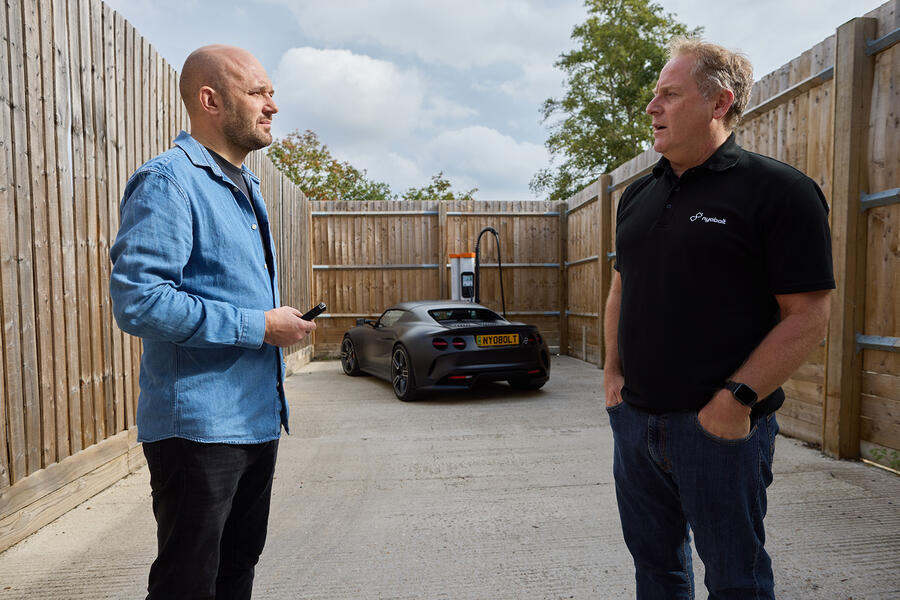
The tech that enables such quick top-ups – therefore allowing a downsized battery to better play into a two-seat sports car's need for agility – "is all based around the cell level", according to Shane Davies, director of vehicle battery systems at Nyobolt.

"What's so different is our anode material within the cell composition, then the system design of the cell itself. It results in very, very low impedance at the cell level, which in turn results in low heat generation. We don't need to work on any trick cooling solutions."
Back to top

Reduced heat management means a much quicker ascent to headline charging speeds, essentially – music to the ears of anyone who's struggled to make the most of motorway Ionitys and their ilk.

"Our charge performance and discharge performance are pretty much symmetrical, which is unusual," says Davies.

One potential use case for Nyobolt technology is in the world of mining, where trucks perform a very regimented routine up and down hills and their regen and battery discharge cycles are highly predictable. Nyobolt also has its eye on the energy-intensive world of AI automation and data centres, an industry under huge pressure to slice emissions while needing to run 24/7.

But its first public contract is in the world of robotics: Massachusetts firm Symbotic is using Nyobolt batteries in its warehouse robots that are 40% lighter than the ultracapacitors they will replace yet possess six times the energy capacity. They increase a SymBot's window of operability while having 10 times the cycle life of lithium ion technology. On which note, the battery of this matt black sports car has been tested through more than 4000 fast-charge cycles – the equivalent of 600,000 miles if you're maxing out its 155-mile range – retaining more than 80% of its battery capacity in the process.

If you're itching to charge up your next EV in a handful of minutes, the forecast for automotive production is closer to the end of the decade.

Back to top

"I would hope by 2028/29," says Ramesh Narasimhan, Nyobolt's executive vice-president, when asked how soon its tech might appear in car showrooms. "In four years' time, the fast-charging network is going to be completely different. Car makers have to think about their customer experience in that scenario."

A world of 10-minute charging would increase public DC charger throughput and thus boost revenues for the charge point owners (or allow them to reduce costs, if we're being truly idealistic) while cutting queues and inconvenience for drivers.

Eight undisclosed car makers are in discussions around adopting Nyobolt's cell technology, which could be retrofitted to current applications. Narasimhan reckons it's a more viable option than solid-state batteries for customers keen to hurdle range and charge anxiety.

"The questions around solid-state batteries concern timeframe and cost and none have been answered," he says. "We believe that this technology, given the competitive nature of it and the customer experience that it brings, is perfect for an automotive application that is here right now."

Will they build it?

A reimagining of a seminal British sports car (one that's no stranger to EV transplants thanks to the original Tesla Roadster and Detroit Electric SP.01), Nyobolt's proof of concept sits in a Callum-designed exterior atop a Lotus Exige V6 chassis. The car has naturally drawn lots of attention with its dramatic looks, modest 1246kg weight and the promise of startling performance.

But could Nyobolt actually build it?

"I think the answer is yes, absolutely," says Shane Davies, whose CV includes the Mercedes SLS Electric Drive and AMG Project One.

"This car is a one-off to demonstrate our capability, but I wouldn't write off the chance of us producing a number of them. A lot of us at Nyobolt are ex-automotive, so we understand when you do that, you've got to think of parts stock, dealers, diagnostics. There's a whole environment around the car to consider. It's more likely that we would look at partnering with an OEM that already has those things in place. You'd be looking at a run of around 50 cars to make it viable."

Join our WhatsApp community and be the first to read about the latest news and reviews wowing the car world. Our community is the best, easiest and most direct place to tap into the minds of Autocar, and if you join you’ll also be treated to unique WhatsApp content. You can leave at any time after joining - check our full privacy policy here.

Add a comment…