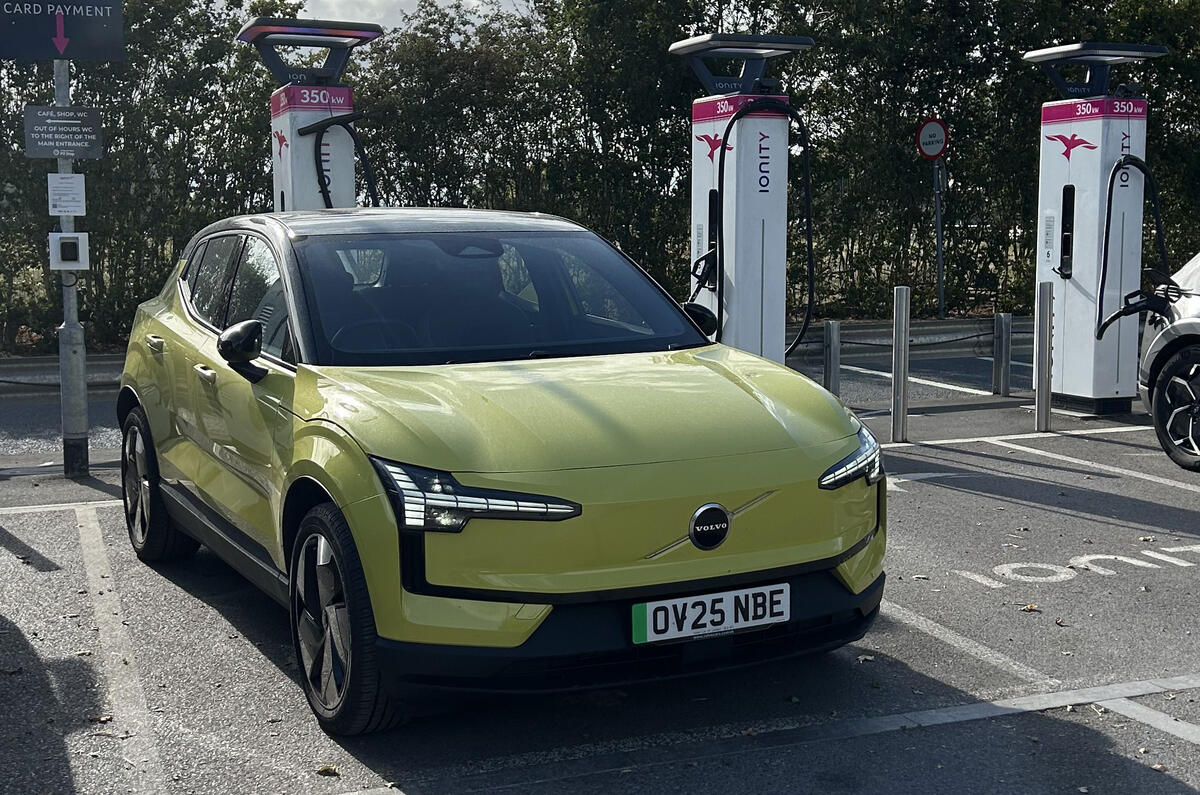
Currently reading: Some Volvo EX30 owners warned not to charge indoors unattended

Owners of Extended Range and Twin Motor models were previously told not to charge past 70%, due to fire risk

Owners of Single Motor Extended Range and Twin Motor Performance versions of the Volvo EX30 have been instructed not to leave their cars unattended while charging indoors or in covered areas, due to a battery fire risk.

Volvo recently identified an issue with battery cells overheating in the long-range versions of the EV, which use a 69kWh pack comprising nickel-managanese-cobalt modules.

Cells that overheat can cause a fire that spreads to the rest of the pack, potentially igniting the rest of the car.

The new advice comes from discussions between Volvo and the Driver and Vehicle Standards Agency (DVSA), after the brand advised owners of these EX30s not to charge to more than 70% to mitigate the risk of fire.

A DVSA notice said: "Currently the investigation is still ongoing with the final service solution being developed."

Owners have been advised to limit the maximum charge level of their cars' batteries to 70% because, Volvo told Autocar, “the risk of this rare issue happening is significantly reduced below this level of charge”. 

A charge limit can be applied through the charge settings menu in the EX30’s touchscreen infotainment system.

If cells overheat, a warning is displayed on the touchscreen stating: “Danger! Battery overheating. Stop safely now and exit car.”

In a statement sent to Autocar, Volvo said the number of such incidents reported so far amounts to 0.02% of all the 33,777 EX30s with that battery built over that timeframe – equating to seven cars.

The company added that there have been no reports of personal injuries related to the fault and that it plans to bring in the affected cars for remedial work.

“We plan to roll out a recall as soon as possible to fix the cars in question,” Volvo said. “In the meantime, we are contacting all affected owners to ask them to limit their cars’ maximum charge level to 70%. We will contact them again as soon as a fix is available. 

"Other models are not affected by this notice and not all variants of EX30 are affected.”

The fault doesn't affect the entry-level version of the EX30, the Single Motor, which employs a different battery entirely – a 49kWh pack using the lithium-iron-phosphate chemistry.

Advertisement

Read our review

Car review

Volvo moves one market niche smaller to bring in younger, climate-conscious buyers

Join our WhatsApp community and be the first to read about the latest news and reviews wowing the car world. Our community is the best, easiest and most direct place to tap into the minds of Autocar, and if you join you’ll also be treated to unique WhatsApp content. You can leave at any time after joining - check our full privacy policy here.

Charlie Martin

Charlie Martin Autocar
Title: Staff Writer

As part of Autocar’s news desk, Charlie plays a key role in the title’s coverage of new car launches and industry events. He’s also a regular contributor to its social media channels, creating content for Instagram, Tiktok, Facebook and Twitter.

Charlie joined Autocar in July 2022 after a nine-month stint as an apprentice with sister publication What Car?, during which he acquired his gold-standard NCTJ diploma with the Press Association.

He is the proud owner of a Mk4 Mazda MX-5 but still feels pangs of guilt over selling his first car, a Fiat Panda 100HP.

Join the debate

Comments
20
Add a comment…
JAVMAN 29 January 2026

It is my understanding the 0.02% figure refers to the manufacturer battery cell failure rate not the % of cars on recall that may be faulty. A 64kWh battery in an EX30 has 294 cells, I can’t find a figure for the cell count in the 69kWh battery, lets assume it’s the same, 0.02% = 1 in 5000 cells, ~ 1 in 17 batteries could have a faulty cell, ~ 600 cars in the UK. That’s a lot more than 7. I got my data from this article. https://carnewschina.com/2026/01/14/sunwoda-chairman-responds-to-volvo-recall-battery-packs-not-supplied-by-sunwoda/ Could someone at Autocar get clairification on this as I hope I am wrong.

harf 29 January 2026

I'm surprised the EU didn't mandate removable battery packs, NIO style, to ensure battery repairs were economically viable.

 I'm curious how you would replace cells on a cell-to-pack design - if have thought it was nigh on impossible?

Arthur Sleep 29 January 2026

A Chinese car.