Currently reading: Ford has to partner with other car makers “to compete" in Europe

American firm announced on Tuesday that it has partnered with Renault to create two “affordable” EVs for Europe

Ford has to partner with other car makers “in order to compete” in Europe, new European boss Jim Baumbick has said.

The American company announced on Tuesday that it had signed a letter of intent with the Renault Group to produce two “affordable” electric cars for Europe on the highly scalable Ampr EV platform.

The first of these new Ford models will arrive in early 2028 and is expected to be a Fiesta successor based on the Renault 5

Baumbick explained that the key reason for partnering with Renault was down to “very competitive cost and scale”. “Partnerships are a critical part of our business,” he said. “In order to compete at the level of cost, we need to ensure that we're getting scale and getting to new levels of material cost and leveraging the supply chain.”

“So when I look at our Ford model programmes that we're developing, we're taking thousands of dollars of cost out through design efficiency, supply chain, different supply chain evolutions and footprints, as well as efficiencies of our execution. But you cannot replace scale, and that's where Renault enters.”

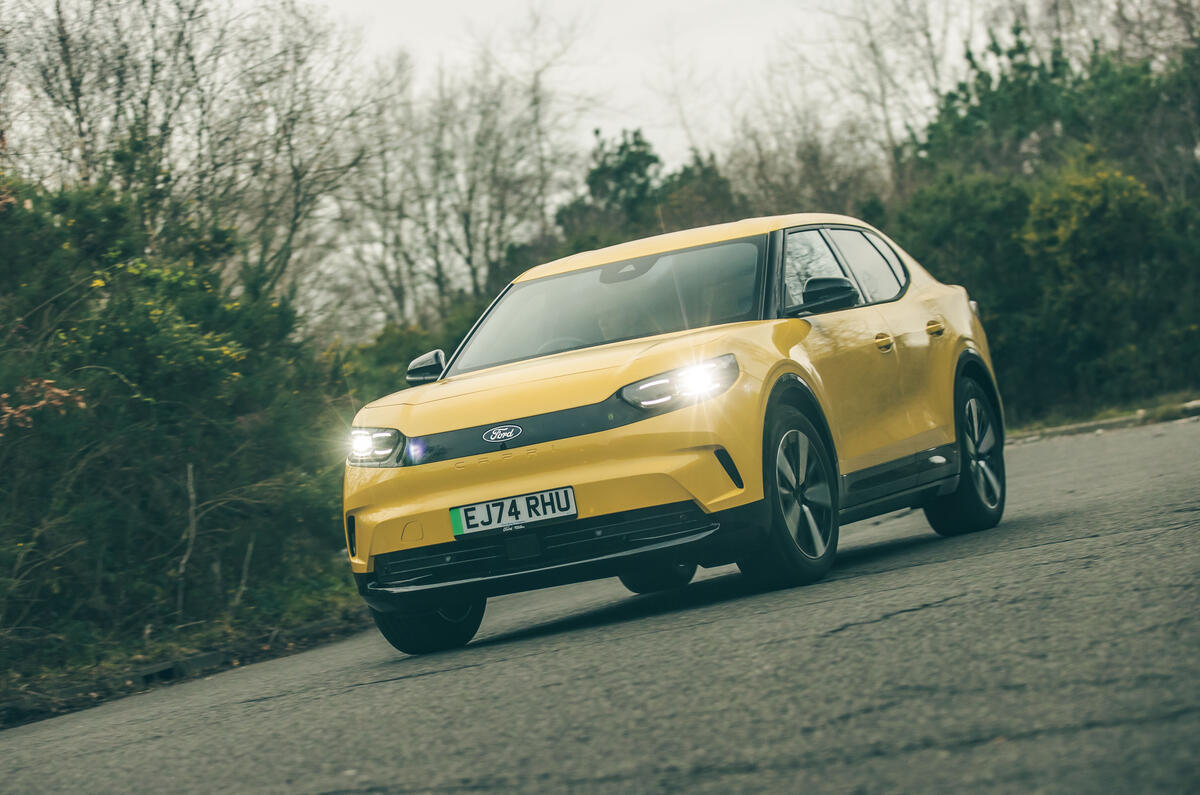
The announcement suggested Ford’s long-standing relationship with the Volkswagen Group could be in doubt. The Ford Explorer and Capri SUVs, both launched last year, are based on the German firm's MEB EV platform and use extensive amounts of Volkswagen parts.

But Baumbick said the Renault tie-up “is a complement to an existing really great relationship with VW” and “I see that as certainly ongoing and something that we're thinking about for the long term, as we did from day one”.

“It is not a pivot away from VW; we have a very clear engagement and strategy with Volkswagen,” he continued. “We looked at a wide range of possibilities to compete in the small EV segment and, given the speed, agility and competitiveness, the Renault Ampr platform is the right choice for us.”

Asked whether the new affordable EVs plan was acknowledgement from Ford that leading its European EV offensive with these large SUVs – which were perceived to offer higher margins than smaller models – was a mistake, Baumbick said: “I would just say that as a company, and probably as an industry, everybody has learned a lot in this first round of EV investments, and as we go into our next round of product investment, that's what I'm most excited about. 

“Ford is making a commitment to really fortify our future in Europe. We are committed to manufacturing and building cars in Europe for Europeans, designed by Europeans.”

Back to top

On what the future now holds for the Explorer and Capri, Baumbick said that Ford was “committed to the product portfolio that we have on the road today, and we think that there's a great opportunity to continue to leverage those investments and improve the business around those vehicle lines”.

Baumbick also committed to the future of the Puma, despite expectations that the second Ampr-based Ford EV will be a small electric crossover derived from the Renault 4, which could fill a similar market segment as the Puma Gen-E.

He said: “We have a very active cycle plan on Puma, and I see these two [new electric] vehicles as an augment to Puma, and we're going to continue to build out that investment profile for Puma. 

“We see Puma as a very key vehicle line in our portfolio, when it has actually been very successful in the marketplace, and something that we're going to continue to kind of lean in on. it will be a core tenant of our strategy.”

Ford also doesn’t expect to bring its new Universal EV Platform to Europe any time soon, said Baumbick. Announced in the US in August, the platform will form the base for a new range of affordable EVs, starting with a mid-size, double-cab pick-up truck that will arrive in 2027, priced at $30,000 (around £22,000).

Regardless of it being a “large breakthrough development” and being “very flexible”, Baumbick said the platform “is a little large and purpose-built to compete in more like a C-sized segment and up”, rather than the B-segment that Ford is now targeting. 

Baumbick said that while “it is flexible to go lower”, this would come with “a very significant undertaking in terms of engineering and cost”, adding: “The right answer for us, especially as we're working through this transition, is leveraging a very competitive platform basis with Renault to position our products.”

Join our WhatsApp community and be the first to read about the latest news and reviews wowing the car world. Our community is the best, easiest and most direct place to tap into the minds of Autocar, and if you join you’ll also be treated to unique WhatsApp content. You can leave at any time after joining - check our full privacy policy here.

Will Rimell

Will Rimell Autocar
Title: News editor

Will is Autocar's news editor.​ His focus is on setting Autocar's news agenda, interviewing top executives, reporting from car launches, and unearthing exclusives.

As part of his role, he also manages Autocar Business – the brand's B2B platform – and Haymarket's aftermarket publication CAT.

Add a comment…