
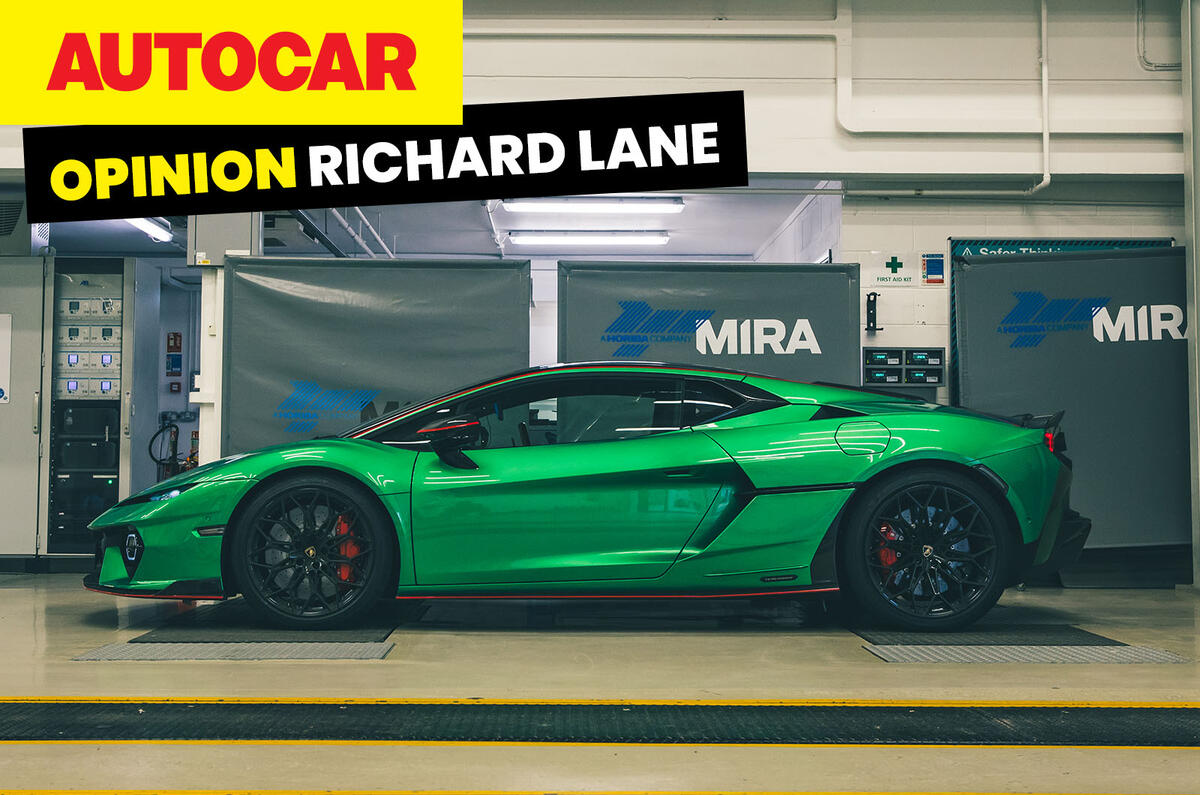
I recently put the new Lamborghini Temerario on the weighbridge at MIRA. It had the Alleggerita pack fitted, which for a trifling £37k saves you about the mass of a Labrador.
Up popped the numbers, one for each corner. I always double-check these green digits as they go in my notebook, but this time was compelled to triple-check. At the facility that houses the weighbridge works an engineer with whom I play guess the weight for every test car. We squinted at the numbers solemnly. Both of us were frankly miles off, more on which in a moment. In the meantime, have a punt yourself.

So how much should a supercar weigh? As little as possible, but we ought to recognise that today's mainstream manufacturers, forced into hybridisation and penned in by lots of other homologation guard rails besides, can't easily go below 1400kg.
I'd therefore say a supercar with the contact patch and engine required to cut it performance-wise in the modern era, along with the cockpit conveniences and safety apparatus we now expect, should be no more than 1550kg-ish fuelled.
That's a fair threshold in an era when we have all but unfettered access to carbon this, Inconel that and very advanced metallurgy.
My mind drifts to the Ferrari 458 Italia. It remains the Platonic ideal of the modern supercar in so many ways, doesn't it? When we road tested one in 2010, it hit 100mph in exactly seven seconds and stopped from 70mph in 41.8m on its Michelin Pilot Sport tyres. Red-hot performance. It did it with 562bhp and in the region of 360bhp per tonne, which feels like the sweet spot for a usable supercar with lots of airbags, air conditioning and a passably good hi-fi system.

Interestingly, the high-brow driver's car du jour, Porsche's stunning 911 S/T, has an almost identical power-to-weight ratio.
Current supercars are another matter: 460bhp or so per tonne is now table stakes. Those mad numbers mask a problem, though, which is that the cars are getting worryingly tubby, even for makers for which lightness is key.
The McLaren Artura we tested in 2022 came in at 1552kg, despite its carbonfibre tub and fairly spartan interior. The Ferrari 296 GTB was 1648kg. (This tallies, given that both use a twin-turbo V6 and a solitary electric motor mated to the gearbox, and a carbon tub typically saves you around 100kg.) These are substantial numbers for machines that still have modest footprints and are purely RWD.


Join the debate
Add your comment
All cars to heavy these days, not just sports cars..
Driven by over-regulation, hence the slow demise of teh European motor industry
It's not over-regulation, but poorly conceived regulation, and it's also due to customer demand.
BMW have basically admitted they don't worry about weight gain, because the customer wants a massive SUV with electric everything, so clearly doesn't care. And a platform optimised for an X5 is going to make a 3 series much heavier.
The frustration is that net zero is a laudable goal, but the route set to get there a complete joke.
It's far too much. All this weight represents material, another two tonnes of metal, plastic and the rest, that needs accelerating, braking and changing direction. In other words, it affects everything.
And it creates a car whose limits are way, way beyond normal road use, and less fun as a result.
What would you suggest we build cars out of?,because there's nothing new at the moment that's cost effective ie cheap enough for mass market cars to be made from.
What does it matter?,there all fast enough really, if they all increased by say 10% overall, they've all still in the same pecking order,and as said in other stories about EV cars, you can still go and buy a secondhand ICE car bargain.