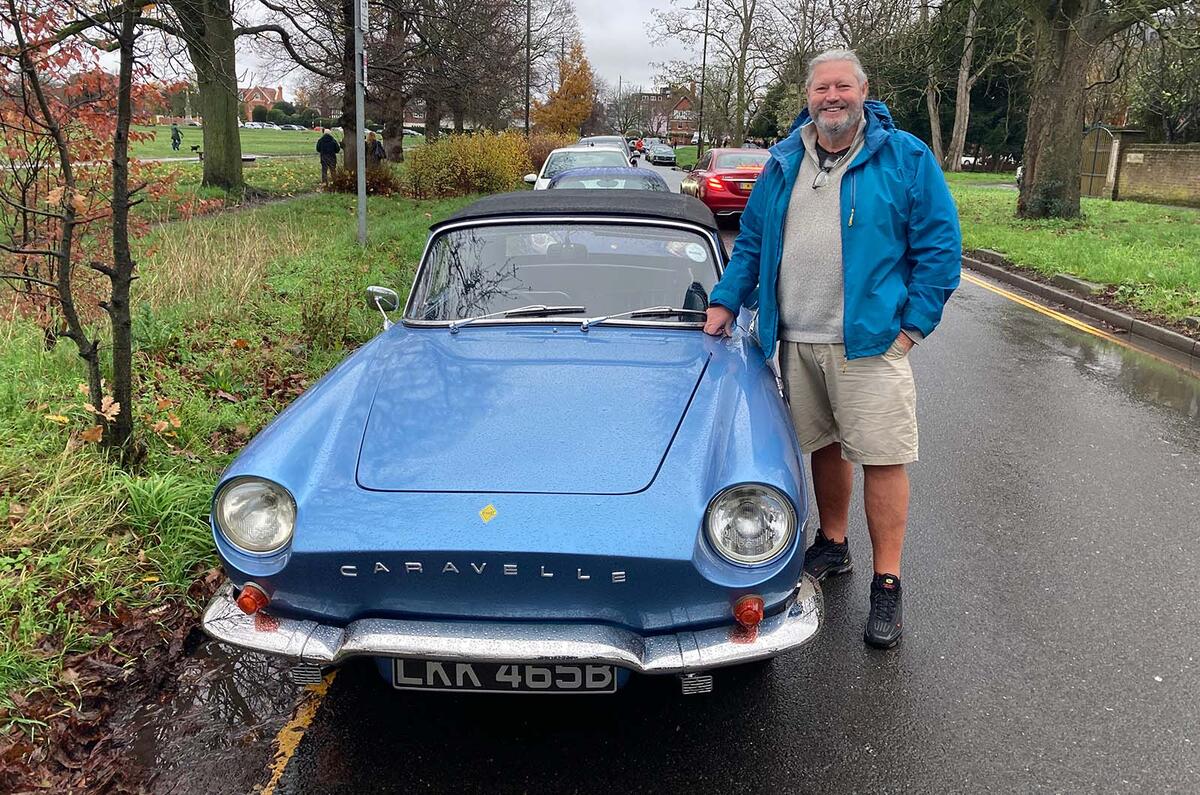
"It's what I call a 'yes, but' car," says Danny Maclean of his Renault Caravelle Convertible 1100.
"Yes, it has brakes, but they have no servo. Yes, it has steering, but it's not power-assisted. People used to call the Caravelle a poor man's Ferrari. I think you'd need to have a drink or two to see it like that, but still, it is rather beautiful."
He's right about that. His Caravelle features some lovely touches, too, such as the very French-looking '1100' script on the engine cover and the mesh grilles either side of the rear numberplate (they're purely decorative).

This model, launched in 1958 in 2+2 coupé, cabriolet and convertible bodystyles, was the work of Carrozzeria Ghia - so that Italian look is no accident. It was supposed to go head-to-head with cars such as the Triumph Spitfire but, at least in Britain, it was almost twice the price. Danny's example was registered in 1963, five years before Caravelle production ceased.
It's the second Caravelle that he has owned. "I bought my first in the late 1970s," he recalls. "It looked so different compared with the Fords and Vauxhalls most people owned. It wasn't in such good condition as my current Caravelle and cost me £675, but someone offered me £700 and I took it.
"I regretted selling it for years, and then 18 months ago I saw this one at a classic car auction. It cost me just over £9000, but I've spent a fair bit on it since."

Not on the car's body or interior, though. The car had been imported from South Africa so hadn't been troubled by salted roads during its life. It had been partially restored, too, although some of this work needed rectifying.


Join the debate
Add your comment
Shall be speedy compared to the original, per 1959 road test the original 850CC did, 0-60mph in 22,4 sec., quarter mile also in, 22,4 sec. That variant weighted 760 kg. With power raised to 55 from 40 -- well it might do, 0-60 in something like 14-15 sec. range. Which is more of a difference for drivability than folks may realize. Difference is keeping up with traffic.