Currently reading: Corners like it's on rails! Driving the Land Rovers built for the railway

Land Rovers are renowned for their go-anywhere versatility, but a British firm has been taking that one step further...

Strange things happen at night - sleepers snore, foxes scream and Land Rovers turn into trains.

Well, not trains exactly, but when we're all tucked up in bed, some do swap their road wheels for train ones and drive along rail tracks. Not only Land Rovers but also Ford Rangers and Isuzu D-Maxes. And no, it's not a desperate way of avoiding potholes; instead, they're vehicles used by rail network operators and contractors to ferry workers, equipment and materials to often remote track locations. They do so at night because that's when the trains stop running: it allows the maintenance companies to have what's called 'track possession time.

Time is of the essence, too. The railway timetable can't be changed or commuters delayed just because workers are on the track surveying it, fixing it, laying fresh ballast, spraying weeds, clearing leaves or the 1001 other jobs they do. So they have a window of around six hours to get in, do the work and get out again - and the best way to do that is with a road vehicle that can quickly drive to a pick-up point, take everyone and everything to the nearest track entry ramp (a short length of concrete on a level with the rails) and speed along the line to the job.

In fact, on the tracks 20mph is as fast as the vehicles are allowed to go, but that's a lot quicker and safer than walking. A British firm called Aquarius is a leading specialist in road-to-rail conversions. Located deep in the countryside near Ripon, North Yorkshire, it was founded in 1996 and employs 25 people. We're all familiar with the term 'test track', but Aquarius does have exactly that: a short stretch of railway track on which it tests its vehicles.

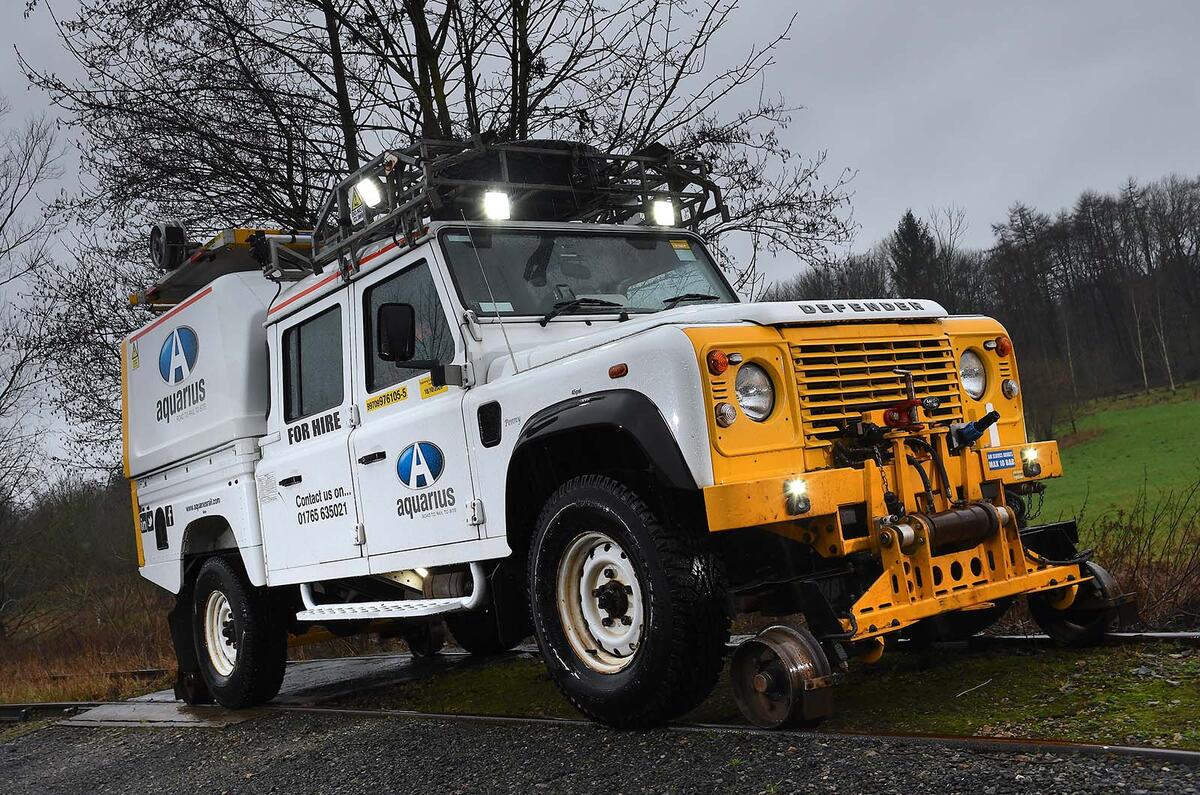
When I visited, there was a Land Rover 130 parked beside it. It looked like a regular Landie but for two pairs of small train wheels: one pair mounted ahead of the front road wheels and the other behind the rears. Kelly Brown, the operations director of Aquarius, climbed aboard and skilfully drove the vehicle up a short entry ramp and square onto the track. Now for the transition: Brown switched off and then restarted the engine, there was a hiss of hydraulics as the rail wheels pivoted down to the tracks and, as they made contact, raised the car and the road wheels slightly.

This action transferred vital load to them, ensuring they were in secure contact with the tracks. With the road wheels also in contact, when Brown engaged first gear and let out the clutch, the Land Rover moved forward, and when she braked, it slowed. Genius, except, I wondered, what would happen when she turned the steering wheel? Happily, Brown explained that on starting the engine, with the road wheels pointing straight ahead, the steering wheel was then automatically locked in position.

Advertisement

Read our review

Car review

The Land Rover Defender is an institution and unbeatable off road, if crude on it

Back to top

It means that, as the car moves along the track, the driver can take their hands off the wheel confident the rail wheels will guide it. It's an autonomous car, then, but not as we know it. Now my turn. For obvious reasons, Brown left the Land Rover parked on the tracks. I took her place in the driving seat as she indicated a panel of switches on top of the dashboard.

The only two I needed to bother with were those controlling the fore and aft train wheels. Deployment was straightforward: start engine, check steering wheel is locked and press and hold one of the switches. This produced a satisfying rumble, rather like an aircraft's undercarriage coming down. The vehicle rose slightly as the rail wheels made contact, and then a locking sound told me they were secure. Repeat for the rear wheels.

Back to top

Now engage first gear and the Land Rover proceeded down the track more smoothly than any 130 has a right to. Cameras and screens gave me a safe, 360deg view. (When on the road, a locking pin ensures the raised train wheels don't deploy unexpectedly.)

Aquarius sells its conversion services to train companies and contractors around the world. With the rail wheels fitted, most vehicles still have a payload of around 800kg and an impressive gross train weight (vehicle and trailer) of seven tonnes. Aquarius also converts vehicles such as the Kawasaki Mule, and Norway's fire service has just ordered one.

At the end of my visit, and faced with a 250-mile drive home in the rain, I was tempted to drive the 130 miles to the nearest main line and, after the trains had stopped for the night, take the direct route - except that at 20mph, and including having to leave the track halfway when they restarted, the journey would have taken a couple of days.

The Pullman experience 

In 2016, Land Rover asked Aquarius to fit its road-to-rail technology to a Discovery Sport not to clear leaves off the line but to tow three luxury train carriages, with a combined weight of more than 100 tonnes, over a distance of 10 kilometres.

In all other respects, the 180hp diesel-powered Disco was standard. Even so, it succeeded, pulling 58 times its own weight along the stretch of Swiss railway - which included crossing the Hemishofen bridge, a steel span measuring 935ft long and soaring 85ft above the Rhine river.

Join our WhatsApp community and be the first to read about the latest news and reviews wowing the car world. Our community is the best, easiest and most direct place to tap into the minds of Autocar, and if you join you’ll also be treated to unique WhatsApp content. You can leave at any time after joining - check our full privacy policy here.

Add a comment…