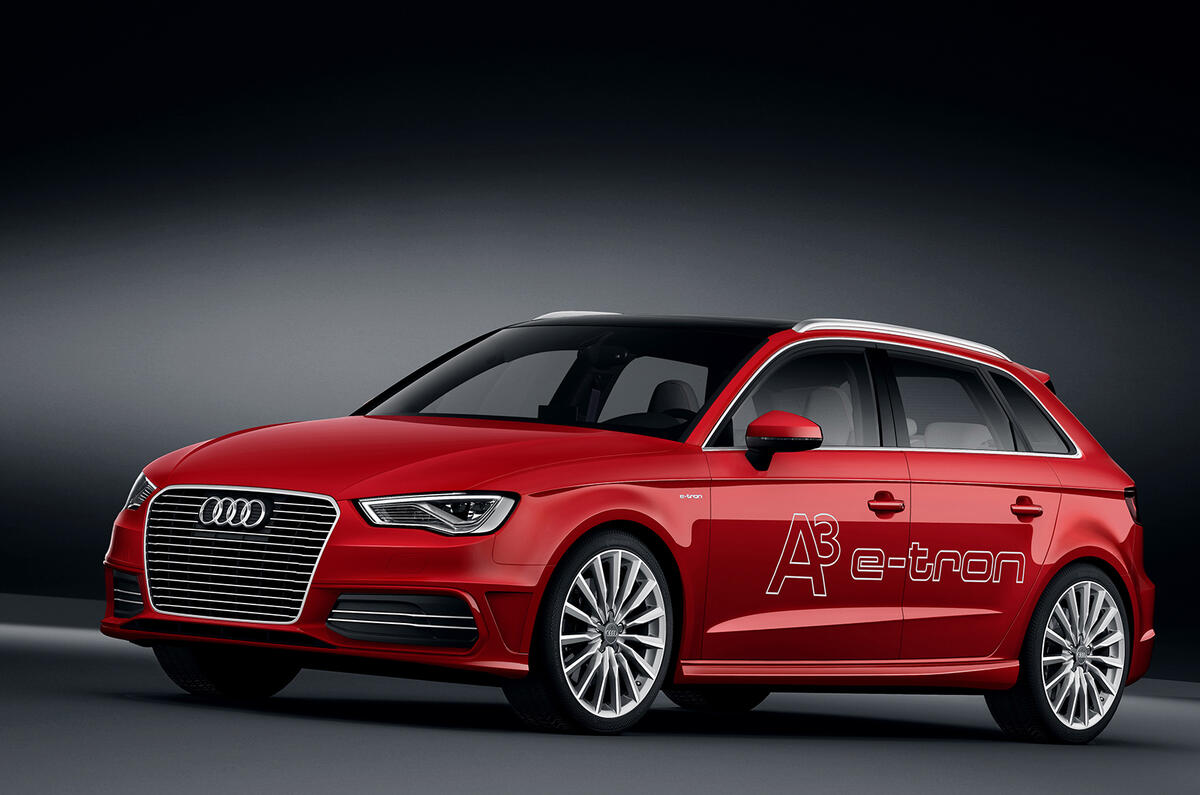

Audi is betting on the electrification of its future cars to improve real-world economy and reduce exhaust pollution, company bosses have told Autocar.
The move will also allow the company to usher in some highly advanced suspension innovations as well as providing a degree of autonomy that goes beyond simple driving assistance.
This shift towards ‘mild hybrid’ systems and more conventional plug-in hybrids should also result in Audi’s future line-up moving away from diesel engines, particularly across the company’s smaller models, including the Audi A1, Audi A3 and Audi A4.
Moving to petrol hybrid engines will also allow Audi to exploit its new ‘predictive efficiency assistant’ technology, which uses mapping information and live traffic reports to automatically switch between power sources, as well as taking advantage of downhill stretches of road to ‘coast’ the engine.
The key to Audi’s move is the adoption of Integrated Starter Generators (ISG). These are large electric motors that act as the starter motor and alternator but can also assist the engine by sending torque through the drive belt to the engine’s crankshaft. The system is also fitted with a small lithium ion battery.
Audi has developed an ISG that works on an ordinary 12V electrical system, so it could be fitted to today’s A1 and A3 models. The company says the system allows the stop-start system to cut in below 9mph and also allows the engine to coast at high speeds, both significant fuel saving measures. The first production version is expected in 2017.
Today’s A3 1.4 TSI Ultra has a claimed economy figure of 60mpg, but the 12V ISG system would push that up to 65mpg. However, the combination of coasting and energy recuperation under braking could see the real-world economy of the ISG-equipped engine rise even higher than the lab figures suggest.
Audi is also planning to introduce a more powerful 48V ISG system, the first of which will be revealed before the end of the year, using a combined 12V and 48V set-up.
The 48V system allows for a much more powerful ISG (up from 1.5bhp to 16bhp) and periods of engine coasting of up to 30 seconds.
However, the introduction of full-scale 48V electronics into future models from 2017 will also allow Audi to introduce electrically driven engine compressors, which will come in two forms. Firstly, otherwise conventional turbochargers that are spun up by an electric motor will be able to provide boost even at very low crankshaft speeds.
The second type, as already seen on the RS5 Competition concept, is a separate electric compressor motor that forces air into the turbochargers at low engine speeds but can also eliminate turbo lag during higher-speed driving.
This 48V electrical system has also allowed Audi to develop three new suspension concepts, which capitalise on the fact that the 48V system provides as much as four times as much power as a 12V set-up.
First to arrive will be an active anti-roll bar system that uses planetary gears driven by small electric motors to couple and uncouple the roll bars individually from the chassis.
Uncoupled, the anti-roll bars will allow a more comfortable ride, but when active, Audi claims reduced understeer, less roll in corners and increased lateral acceleration. However, the anti-roll bars’ twisting when locked allows the small electric motors to act as generators and create enough charge on a “moderate bumpy road” to power the whole system.