Currently reading: How Ford transformed its best-seller into an EV

Rollercoasters and Formula 1 – it wasn't just a simple case of swapping the engine for a battery

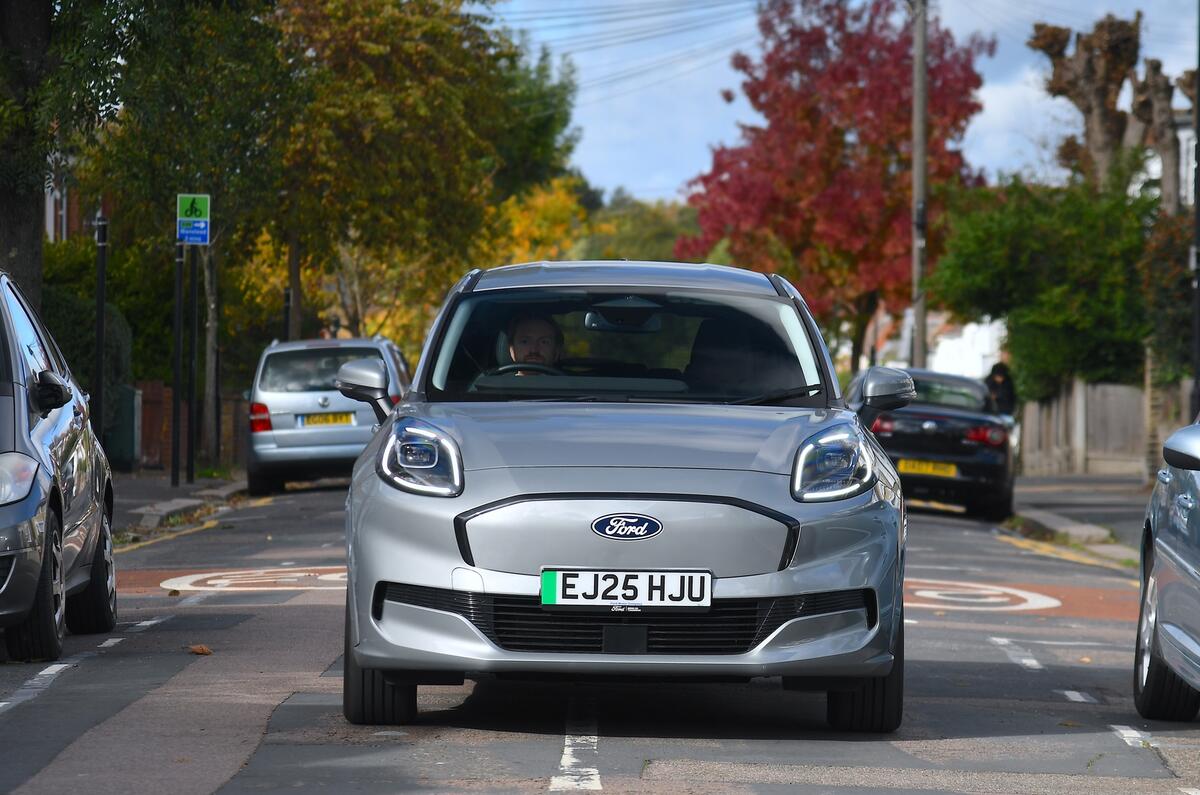
The Ford Puma Gen-E is a curious thing: an internal combustion car reverse-engineered to host a battery-electric powertrain.

Yet its small drive battery and subsequent short range are really the only obvious clues that the Gen-E isn't a bespoke EV. 

Our road testers awarded both the petrol Puma and electric model four stars, which is pretty good going. Many of us have wondered how Ford pulled off this feat, so I decided to ask someone who knew: Dieter Leffers, the Puma's lead engineer. 

MSc: Why turn the Puma into an electric car? 

DL: We saw all of our competitors moving to electric cars and we thought: what is the quickest way to react to market demands? The Puma is obviously our most successful ICE car [being the overall best-seller in the UK since 2023], so what better car to turn into an electrical story? 

We wanted to keep the Puma DNA, so we didn't really touch the exterior. But we focused a lot on the interior. We wanted to achieve maximum connectivity. Screen size was important for us. As was the ability to fulfil the big space in a small car ethos. 

Range was one of the biggest points. We wanted the maximum range possible but to keep it affordable, which meant [fitting] a small battery. 

MSc: I'm finding the range pretty good. On short trips, the Puma Gen-E is incredibly efficient. 

DL: We put a lot of effort into aero optimisation. The underbody is completely covered, like on an F1 car. There's the shooting brake rear spoiler, too, and it's closed at the front end. The electric engine is coaxial, so the transmission is in front of the output shaft and goes straight to the drivetrain, not losing energy and maximising efficiency. 

MSc: What was the biggest challenge you faced? 

DL: To get into the market as quickly as possible. Development time was shortened by one year compared to normal [for Ford]. How we did it was we took existing DNA and put it into a different platform. Keeping the platforms means the EV and ICE cars share a common wheelbase, which meant keeping the four-star [Euro NCAP] crash rating.

It's compromised mostly on traits not visible to the customer. There's less leg room in the rear technically but more room for your feet. 

MSc: More room in the boot, too. 

Advertisement

Read our review

Car review

Ford's best-selling compact crossover finally gets an all-electric powertrain

Back to top

DL: Yes, the [underfloor] Gigabox is excellent. It's amazing how much space you can free up when you remove an exhaust. 

MSc: How about the batteries: how did you fit them in there? 

DL: The cells have been packaged to the bare minimum: there's almost no space [left] in there. Unlike competitors, we didn't move the [car's] hardpoints - the front or rear wheels. We packaged the battery in the underbody, which brings the centre of gravity down further. And we kept the motor in front, rather than moving it to the rear. 

MSc: I love hearing about the titbits. The fun stuff... 

DL: I have a good story that I don't think anyone outside of Ford knows. I asked my NVH team for a special pedestrian warning sound. They offered up all the wrong ones. So I sent them to Phantasialand [a theme park near Cologne] to go and listen to the electric rollercoasters there.

They measured all the noises and came up with the fantastic sound, which borrows from the magnets of the rollercoaster and a bit of three-cylinder crackle from the petrol Puma. 

MSc: I wish my bosses would send me to a theme park on a fact-finding mission...

Join our WhatsApp community and be the first to read about the latest news and reviews wowing the car world. Our community is the best, easiest and most direct place to tap into the minds of Autocar, and if you join you’ll also be treated to unique WhatsApp content. You can leave at any time after joining - check our full privacy policy here.

Murray Scullion

Murray Scullion
Title: Digital editor

Murray has been a journalist for more than a decade. During that time he’s written for magazines, newspapers and websites, but he now finds himself as Autocar’s digital editor.

He leads the output of the website and contributes to all other digital aspects, including the social media channels, podcasts and videos. During his time he has reviewed cars ranging from £50 - £500,000, including Austin Allegros and Ferrari 812 Superfasts. He has also interviewed F1 megastars, knows his PCPs from his HPs and has written, researched and experimented with behavioural surplus and driverless technology.

Murray graduated from the University of Derby with a BA in Journalism in 2014 and has previously written for Classic Car Weekly, Modern Classics Magazine, buyacar.co.uk, parkers.co.uk and CAR Magazine, as well as carmagazine.co.uk.

Add a comment…