
Currently reading: Why Ford chose Renault over Volkswagen for small EVs

Selling the 5's underpinnings to Ford was a coup for Renault, catching much of the industry off-guard

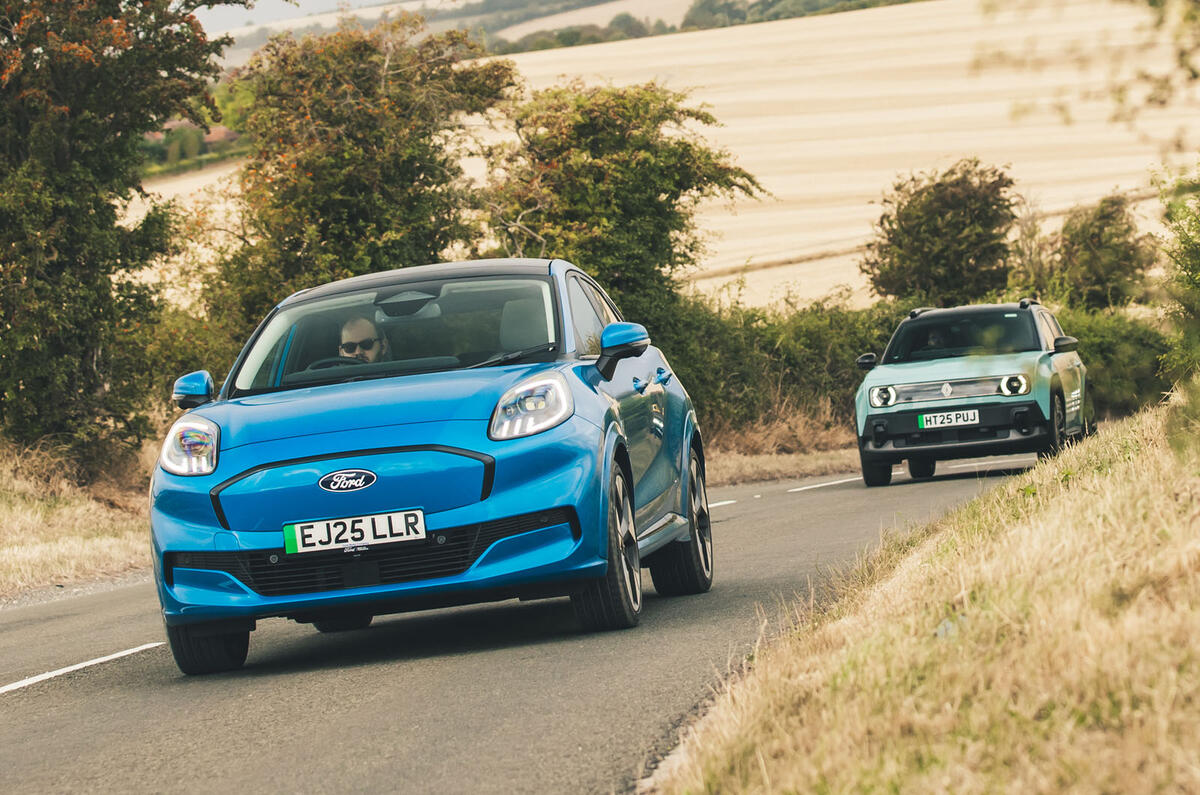
Renault’s coup in landing Ford as a customer for the small EV platform underpinning the 5 is all the more impressive given Ford’s already deep relationship with the Volkswagen Group on EVs.

Ford currently builds the Explorer and Capri electric compact SUVs on the German company's MEB EV platform at its plant in Cologne, Germany, and the two maintain broader co-operation on vans.

So when Ford went looking for a platform for an electric replacement for the Fiesta supermini, the obvious choice would have been Volkswagen's new truncated, front-wheel-drive MEB Plus.

Volkswagen's small EV push will start next year with the ID Polo, built alongside the Cupra Raval, and the platform could have easily supported a Fiesta replacement and a planned second model, likely to be a small SUV. Volkswagen's platform offers those too in the form of the upcoming taller ID Cross and Skoda Epiq.

But the advantage of loose partnerships rather than something more formal is that you can shop around. Ford did and found a better alternative.

Ford CEO Jim Farley told journalists this wasn’t a case of “lovers looking for new lovers” but something more pragmatic.

“First of all, we have deep understanding of Volkswagen's industrial system," he said. "We industrialised the MEB platform in Cologne. We build their platform. We know their supply chain. We know their cost. And you know, we understand their strength and their opportunities." 

Farley said Ford made a “thorough investigation for multiple years” in its search for the right platform for the Fiesta replacement, confirming reporting from 2023 that the end of the ICE Fiesta wasn’t the end of Ford’s journey in small cars in Europe.  

Then Renault came calling. Former CEO Luca de Meo and current CEO François Provost, then head of partnerships, visited Detroit in March this year and proposed building Ford cars on the company’s small EV platform built in its plant in Douai, France. Suddenly Ford’s options widened and eventually a deal was struck.

Why did Ford go with Renault? “Not one particular reason, but cost is among the top,” Farley said.

Renault was a late runner in the decision, but its success in brining Ford into its electric Ampere stable is a significant win in the teeth of competition from Volkswagen, with its far bigger sales.

We don’t know the picture from the perspective of Volkswagen, which might not have been able to accommodate Ford at its two plants in Spain that are poised to make small MEB EVs. 

Back to top

But Volkswagen had worked hard on the profitability of the new small EVs. It said back in May that its ID babies would be the first to reach margin parity with their ICE benchmark, here the T-Cross, thanks to cost savings such as switching to lithium-iron-phosphate (LFP) batteries.

Knowing all that, Ford still went with Renault. Provost was delighted. “It gives us confidence that our Ampere concept and our vision to develop competitive, large-scale EV technologies, including software in Europe, is on good track,” the CEO said at the same Paris announcement on 8 December.

Renault has worked hard to slash costs, for example by cutting development time from a standard four years to a claimed three years on the 5 and less than two for the new Twingo

Ford’s target of 2028 for the first release of the Fiesta successor stretches those numbers, but we’re promised designs from Ford that will go beyond the surface restyling of the 5 by Nissan for the new Micra.

“We will fully differentiate the design,” Jim Baumbick, the new head of Ford of Europe, told journalists on a call. “The positioning will be very different.”

The timing also “synchronised with Renault’s technology development”, Baumbick said, meaning that the launch will coincide with a round of facelift updates that’s likely to bring LFP batteries, faster charging and other improvements.

“We looked at other solutions that actually would be longer in terms of time horizon, and [speed] was one of the factors inclusive of the cost competitiveness of the platform,” he said.

The decision on who to partner for small EVs came after period of soul-searching at Ford about its car strategy in Europe, which was clearly still not delivering cost-savings after years of restructuring, partly because its electric models (including the Explorer, Capri and Puma Gen-E) weren't profitable. 

“We could see the Chinese were coming. We knew about our choices and we spent more than a year studying on paper all the possibilities for our future in Europe. Everything was on the table,” Farley said.

Back to top

He didn’t say this out loud, but one possibility would have been simply heading out of the door.

A big saving factor was the ongoing success of Ford's vans. Ford has a market-leading and profitable position with the Transit range in Europe, and van sales are too intertwined with car sales for the company to bail completely or reduce volumes in order to just focus on ‘hero’ models, including the forthcoming European-spec, plug-in hybrid Bronco SUV.

“Our dealers need a certain scale on passenger cars to be successful on light commercials,” Farley said. “They have some dependency with each other.”

Ford experience in Cologne, when it angered its workforce by shutting down Fiesta production and moving it onto the Volkswagen MEB platform with the Explorer and Capri, only for those models not to sell in the numbers hoped for, made the Renault option more appealing.

Unlike Volkswagen in Spain, Renault has already got 5, 4 and Micra production up and running at its ElectriCity plant in Douai, powered up with three shifts a day. In a region where EV production has been lumpy, pairing a successful model and platform with a plant running at full speed must be a huge relief.

“Renault has very high scale and very competitive material costs,” Baumbick said. “When I look at our Ford model programmes that we're entering and developing, we're taking thousands of dollars of cost out [of each production unit] with design efficiency, supply chain evolutions and footprints, as well as efficiencies of our execution. But you cannot replace scale, and that’s where Renault enters.”

Join our WhatsApp community and be the first to read about the latest news and reviews wowing the car world. Our community is the best, easiest and most direct place to tap into the minds of Autocar, and if you join you’ll also be treated to unique WhatsApp content. You can leave at any time after joining - check our full privacy policy here.

Add a comment…